
How is HIV different from AIDS?
HIV affects CD4 T cells, which help coordinate immune responses. Without treatment, the CD4 count can fall over time and increase the risk of opportunistic infections or certain cancers. AIDS is the most advanced stage of HIV, defined by a very low CD4 count or specific illnesses. HIV and AIDS are not the same, and effective treatment prevents HIV from progressing to AIDS.
HIV medicine, called antiretroviral therapy (ART), lowers the amount of virus in your blood so much that tests can no longer find it. The sooner you start, the better it protects your immune system and the less you get sick. And if you take your medicine regularly and stay undetectable, you will not pass HIV to a partner through sex. This is the idea known as U=U.
A long, healthy, fulfilling life
- Medicine keeps the virus undetectable
- Immune system stays strong
- No sexual transmission (U=U)
Can progress to AIDS
- Immune system slowly weakens
- Higher risk of opportunistic infections
- Preventable with early treatment
U=U · Undetectable = Untransmittable — people living with HIV who take their medicine regularly and stay undetectable do not pass HIV to a partner through sex.
How is HIV transmitted?
HIV only spreads when a body fluid carrying enough of the virus gets into another person's bloodstream. There are just a few main routes: vaginal or anal sex without protection, sharing needles or injection equipment, and passing from mother to child during pregnancy, birth, or breastfeeding when the mother isn't getting care. Blood used in health services is screened first, so the risk there is very low.
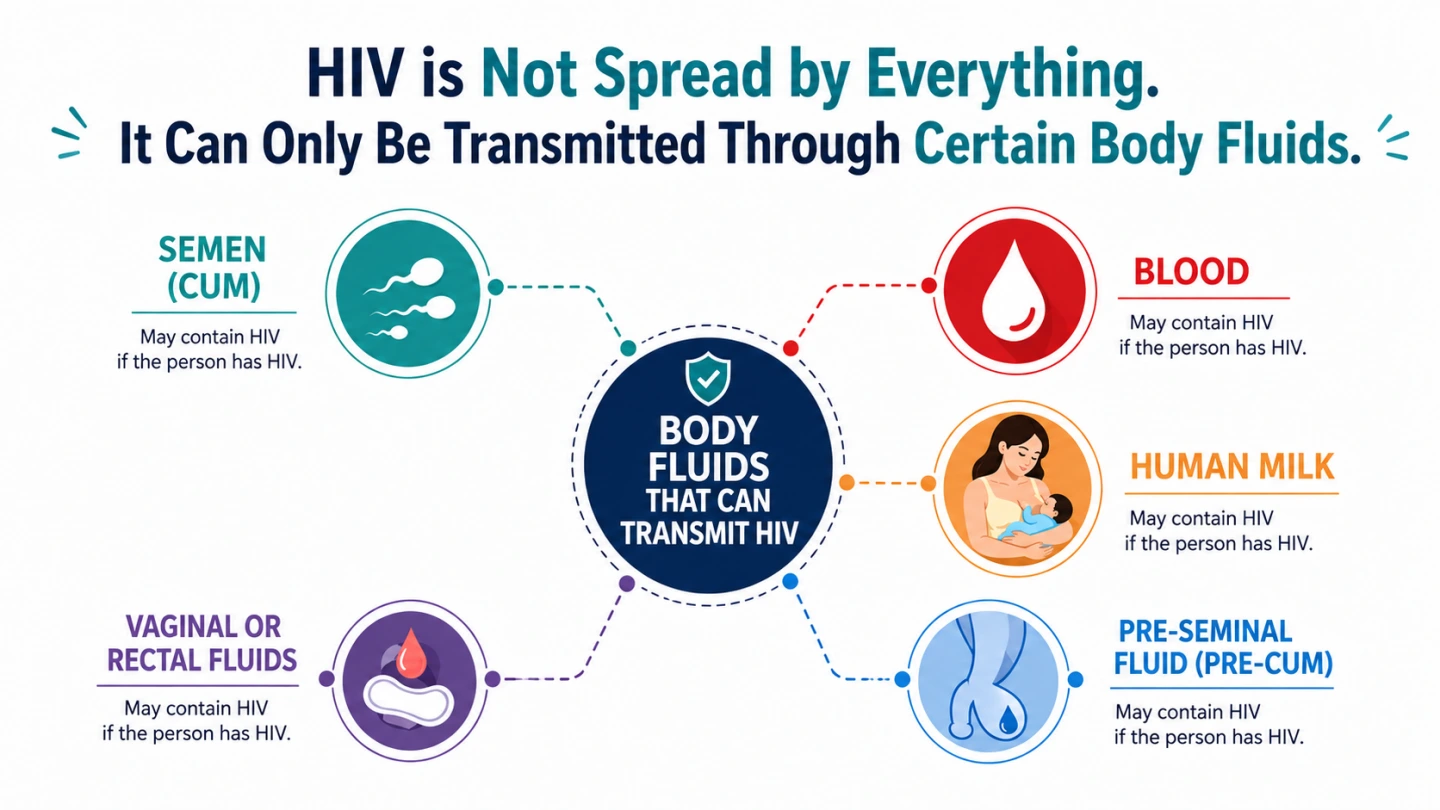
A fluid must contain transmissible HIV and contact a mucous membrane, damaged tissue, an open wound, or enter the bloodstream directly.
- Blood
- Semen and pre-seminal fluid
- Vaginal fluid
- Rectal fluid
- Human milk
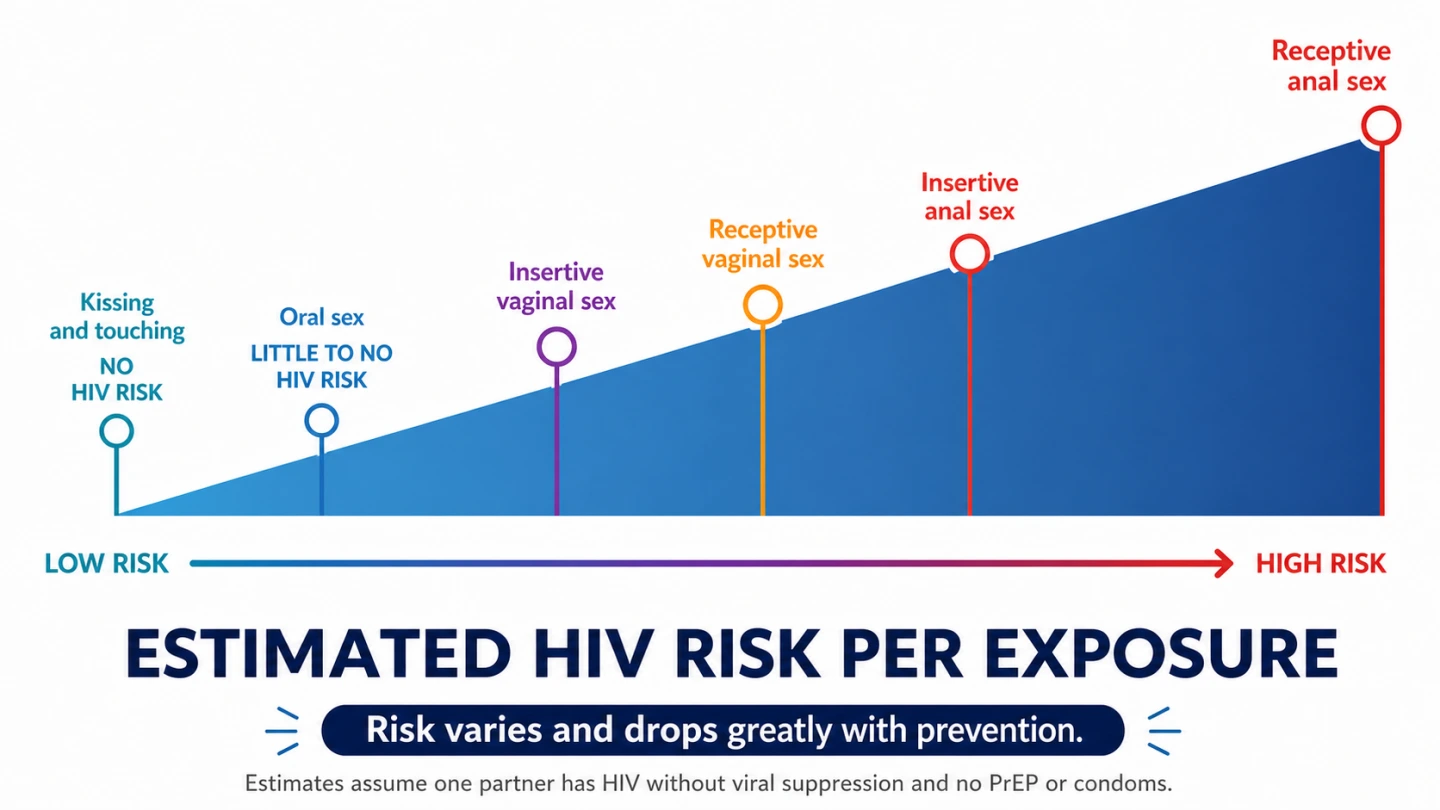
These estimates per 10,000 acts assume one partner has HIV and is not virally suppressed, with no condom, PrEP, or other prevention method.
- 0: Kissing and touching — No HIV risk
- Low: Oral sex — Extremely low to no risk
- 4: Insertive vaginal sex — About 4 per 10,000 acts
- 8: Receptive vaginal sex — About 8 per 10,000 acts
- 11: Insertive anal sex — About 11 per 10,000 acts
- 138: Receptive anal sex — About 138 per 10,000 acts
Can symptoms tell you your HIV status?
Symptoms alone cannot confirm or rule out HIV. Soon after acquiring HIV, some people develop fever, sore throat, rash, swollen lymph nodes, or tiredness, but these resemble many common illnesses and others have no symptoms for a long time. The only way to confirm HIV status is to use an appropriate HIV test at the right time; depending on the test, the sample may be blood or oral fluid.
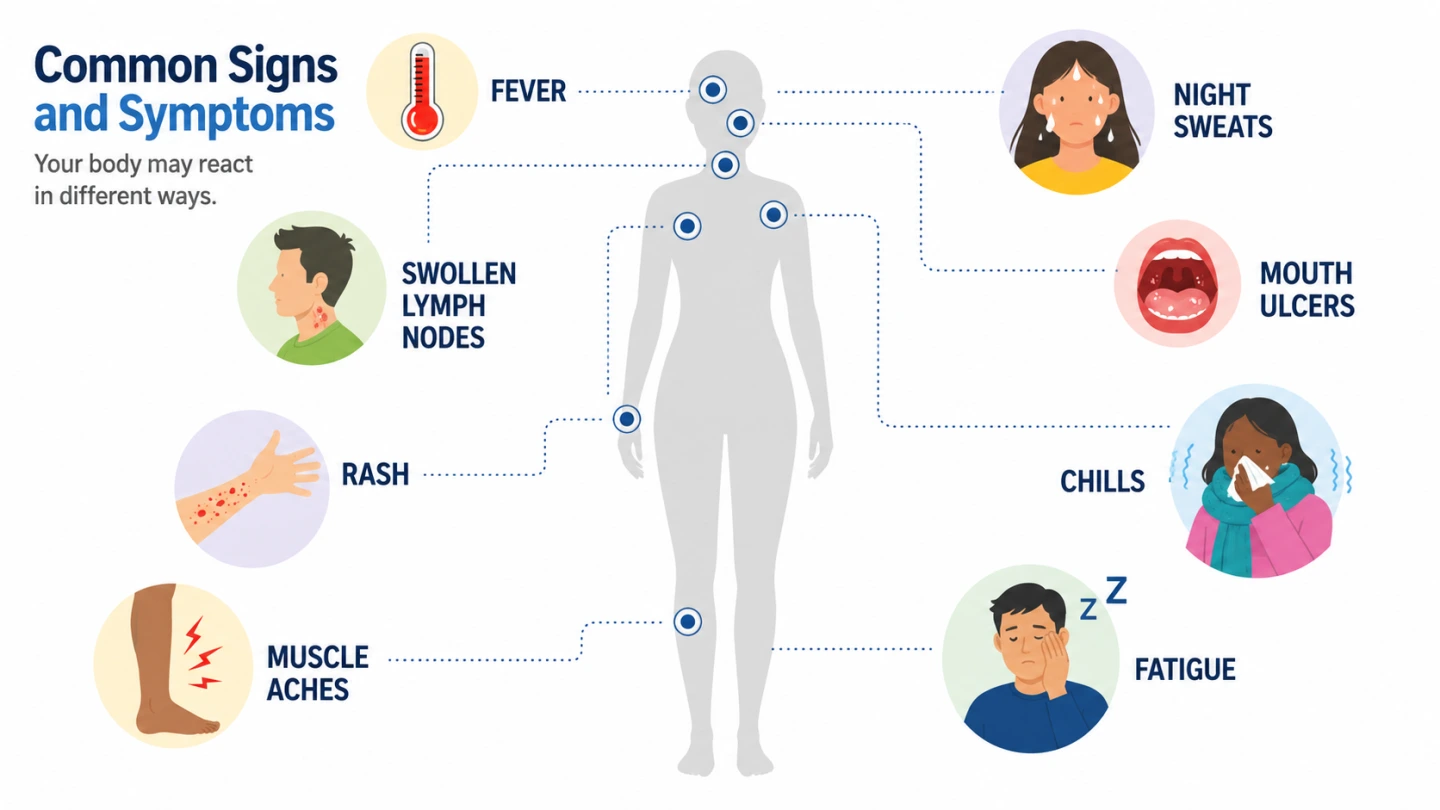
Some people develop a flu-like illness early after acquiring HIV, while others have no symptoms. These symptoms are nonspecific and cannot diagnose HIV.
- Fever
- Swollen lymph nodes
- Rash
- Muscle or joint aches
- Night sweats
- Sore throat or mouth ulcers
- Chills
- Fatigue
Reducing stigma with facts
People living with HIV work, study, exercise, build relationships, and have families. Respectful, person-first language helps people feel safer seeking testing and treatment. Disclosure decisions can involve privacy, trust, personal safety, and applicable law; people deserve accurate information and support without pressure or unauthorized sharing of their health information.
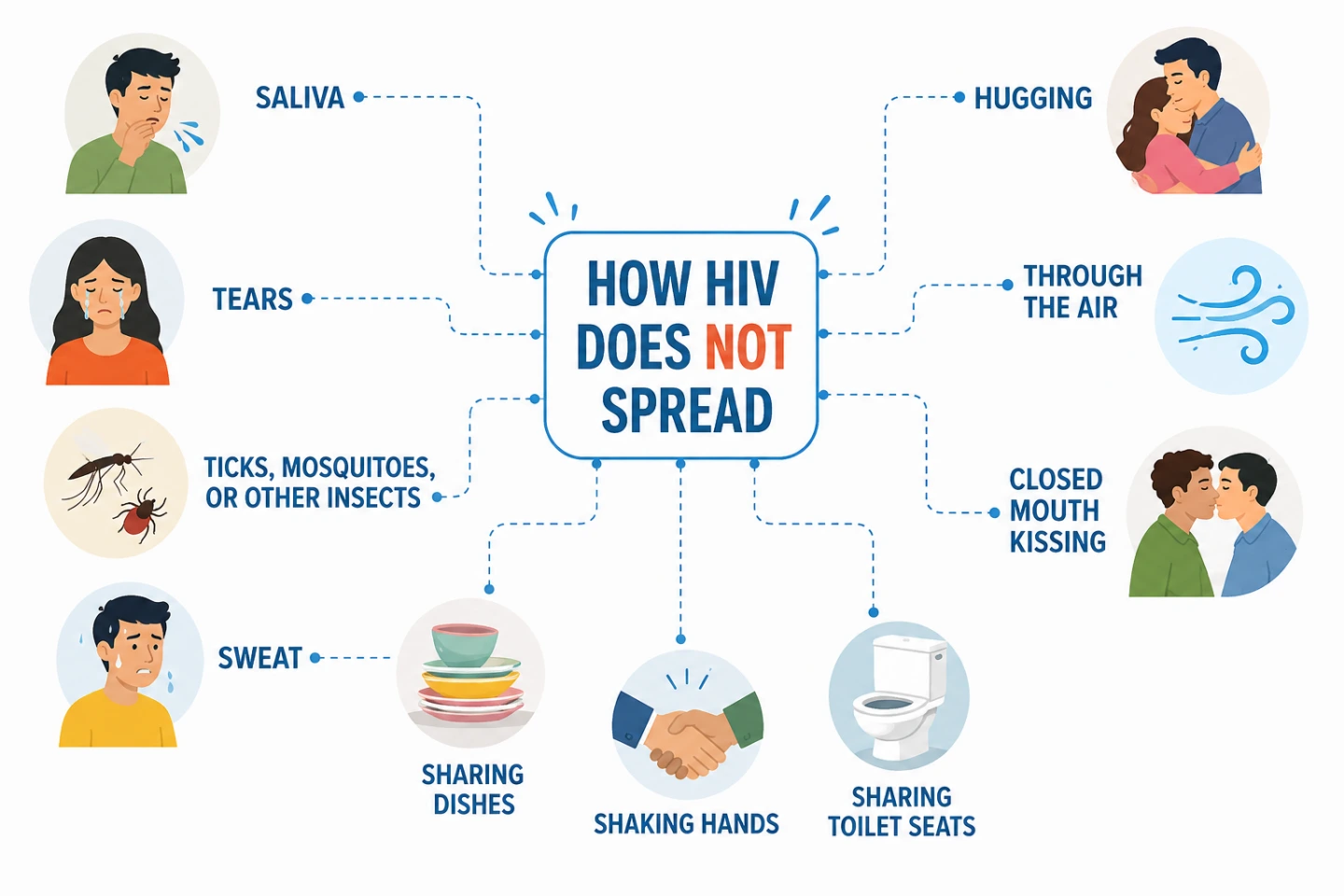
You can safely live, learn, work, share meals, and use common spaces with someone living with HIV.
- Hugging or shaking hands
- Sharing food or dishes
- Sharing toilet seats
- Mosquitoes or other insects
- Air or water
- Saliva, tears, or sweat
- Closed-mouth kissing
- Living or working together
How should you start?
Check your risk Think about what happened and when.
Within 72 hours, ask about PEP The sooner you start, the better it works — don't wait for symptoms.
Get an HIV test Pick the method that fits the time since your exposure.
Consider PrEP If you may be exposed again, PrEP protects you ahead of time.
If positive, start care right away Starting ART early keeps you healthy and leads to U=U.
Frequently asked questions about HIV
How are HIV and AIDS different?
HIV is a virus. AIDS is the most advanced stage of infection when the immune system is severely damaged or an AIDS-defining condition occurs. Effective ART prevents progression to AIDS.
Can symptoms show whether someone has HIV?
No. Some people have no symptoms, and early symptoms overlap with common illnesses. An appropriate HIV test is the only way to know status.
What should I do after a recent possible HIV exposure?
If it happened within 72 hours, seek urgent PEP assessment. PEP should be started as soon as possible rather than waiting for symptoms.
What does U=U mean?
A person taking ART who maintains a viral load below 200 copies/mL does not transmit HIV through sex. Treatment and monitoring must continue.
Does one negative HIV test always rule out HIV?
Interpretation depends on test type, time since exposure, and PrEP or PEP use. Repeat testing may be needed during the window period.
Continue with HIV testing and window periods, PrEP before exposure, PEP within 72 hours after exposure, or find an HIV and sexual-health clinic.
How HIV affects the immune system over time
HIV mainly attacks CD4 cells, which help run the immune system. Without treatment, the virus copies itself again and again and slowly lowers the number and strength of these cells. This can happen at very different speeds. Someone may feel fine for years while damage is going on quietly — which is why symptoms cannot tell you whether HIV is present.
AIDS is not a different virus. It is the most advanced stage of untreated HIV, when the immune system is badly damaged or serious illness appears. Today, ART can stop the virus from copying, let the immune system recover, and support a long life. People diagnosed early and put on treatment do not have to reach AIDS, and even those who are already very sick can improve a lot with the right care.
What has to happen for transmission to be possible
For HIV to spread, a fluid carrying enough virus has to reach another person's bloodstream or vulnerable tissue while the virus is still alive. The fluids that matter are blood, semen, rectal fluid, vaginal fluid, and breast milk.
- Anal or vaginal sex without an effective prevention method
- Sharing injection equipment
- Pregnancy, birth, or breastfeeding when the virus is not controlled by treatment
- Work-related exposure, which is uncommon and handled with an emergency protocol
Stages, symptoms, and why symptoms are unreliable
Soon after getting HIV, some people get a fever, sore throat, rash, headache, muscle aches, diarrhea, or swollen glands — usually two to four weeks later. Others feel little or nothing. These signs look like the flu, COVID-19, dengue, and many other illnesses. HIV can then go quiet for a long time, and without treatment the weakened immune system can later allow tuberculosis, serious infections, or some cancers.
No set of symptoms can prove or rule out HIV. Someone who looks healthy can have it, and someone with many symptoms may not. The right response to a possible exposure is simple: ask about PEP within 72 hours, test with the right method at the right time, repeat testing if advised, and see a doctor for serious symptoms. Testing early is not a punishment — it opens the door to prevention if negative and to very effective treatment if positive.
Language that reflects current science
Words matter. Say "people living with HIV" instead of defining someone by an infection. "HIV positive" can describe a confirmed result; "AIDS" should only mean the clinical stage, not every diagnosis. "Undetectable" means the viral load is too low for the test to report — it does not mean the virus is gone. "U=U" means a person on treatment who stays undetectable has zero risk of passing HIV through sex.
When HIV is described as a punishment, people avoid testing and hide treatment. When it is described honestly — as a preventable, treatable health condition — people are more likely to seek care. When you correct a myth, add the real facts and a useful action: swap fear about sharing food for advice about testing, PrEP, condoms, sterile equipment, and treatment.
What to do with this knowledge
If you had no recent exposure, use this to build a simple prevention and testing routine. If a possible exposure was within 72 hours, seek PEP urgently. If more time has passed, arrange testing and tell the provider the date so they pick the right test and follow-up schedule. A reactive screening result still needs a confirmation test, and while you wait, avoid donating blood and keep using prevention that works for you.
After a confirmed positive result, connect to an HIV clinic quickly. First visits usually include viral load, CD4, and safety tests, screening for other infections, and a review of your medicines. Treatment is recommended for everyone with HIV and can often start right away. Ask about staying on your medicine, privacy, U=U, relationships, family plans, and mental health. One result begins a care journey — it does not end your future.
Replace stigma with practical support
Stigma makes people put off testing, stop treatment, or hide questions until a problem gets urgent. Good information should lower fear, not add a new label. Today HIV is a manageable long-term condition, many bacterial STIs can be cured, and viral ones can often be treated, monitored, or prevented with vaccines. A diagnosis does not define a person's relationships, future, or right to respectful care — so talk about the person before the illness.
Support can be simple: go along to a clinic if you are asked, help with transport, listen without pushing for details, remind them treatment works, and keep things confidential. Do not pressure anyone to share a result before it is safe. Community groups and friendly clinics ease isolation, but they do not replace emergency or specialist care. A culture where testing is normal and treatment is nonjudgmental protects more people than fear ever does.
Continue to communication and consent
Conversations about results, prevention, boundaries, and consent should be respectful, free from blame, and guided by safety. The dedicated guide brings together practical steps, conversation starters, partner notification, privacy, and ways to get professional help.