
If the exposure just happened, act now
- Check the time: if it is within 72 hours, contact an emergency department, HIV clinic, or PEP service immediately.
- Do not wait for symptoms: early infection often has no symptoms, and symptoms cannot determine HIV status.
- Do not delay an indicated first dose: CDC guidance supports giving the first dose promptly and revising the plan when more information becomes available.
- Share practical details: time, exposure route, condom breakage, injection equipment, source status, medicines, and recent PrEP or PEP.
What is PEP?
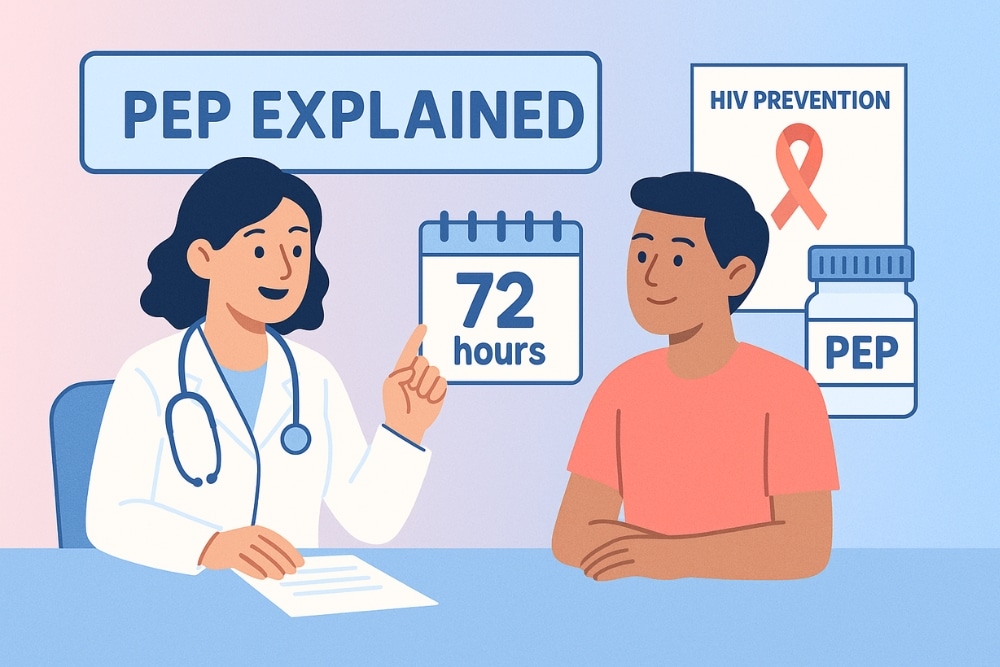
PEP stands for post-exposure prophylaxis. It uses a complete antiretroviral regimen to stop HIV from establishing permanent infection after a potential exposure. It is generally prescribed for 28 days. PEP is not a “cleanse,” and it is not guaranteed to work in every case. Starting promptly, completing the course, and avoiding new exposures are important.
Situations that may need assessment include condomless anal or vaginal sex, a condom breaking, shared injection equipment, a needlestick, or potentially infectious blood or sexual fluids reaching a mucous membrane or broken skin. Saliva, sweat, tears, and urine without blood generally do not warrant PEP, but a clinician should evaluate uncertain situations rather than relying on online risk calculations.
What does the service assess?
The clinician considers the fluid, route into the body, time since exposure, and—if known—the source person’s HIV and viral-load status. Baseline testing supports safe medicine selection and follow-up. When PEP is indicated, it should not be delayed while waiting for every result.
- A baseline blood HIV test
- Kidney and liver tests for regimen selection
- Hepatitis B and C assessment where relevant
- Syphilis, gonorrhoea, and chlamydia tests at exposed sites
- Pregnancy testing where relevant and discussion of breastfeeding
- A review of prescriptions, supplements, allergies, and medical conditions
If baseline testing confirms pre-existing HIV, the service will move from PEP to a complete HIV treatment plan. Do not continue an incomplete PEP combination without specialist review.
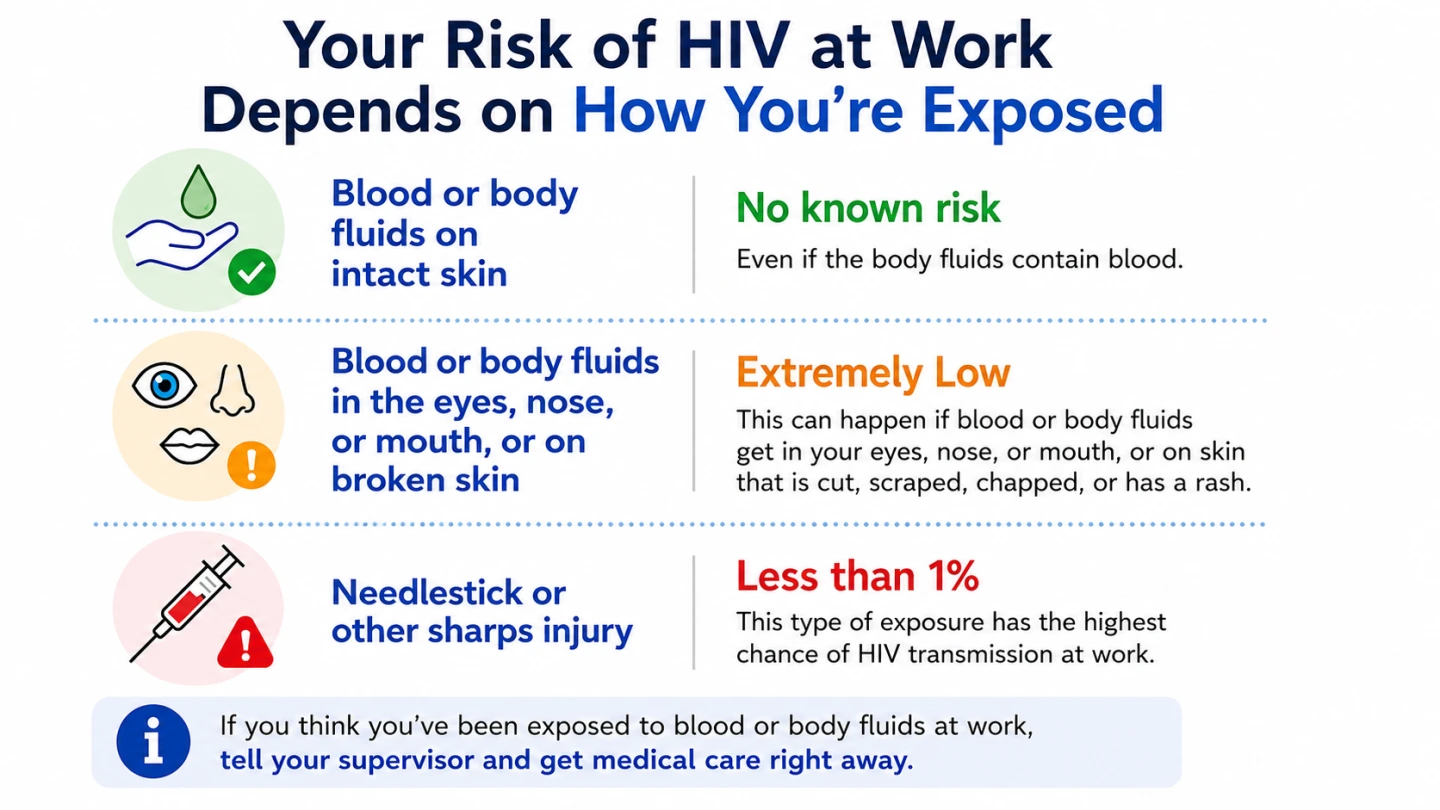
These averages assume exposure to blood containing HIV before PEP. Actual risk varies with fluid, volume, injury depth, and the source person’s viral load.
- No known risk: Blood on intact skin — Wash with soap and water; do not squeeze or scrub.
- About 0.09%: Blood in the eyes, nose, or mouth — Flush with clean water or saline and seek immediate assessment.
- Lower than mucosal: Blood on non-intact skin — The precise average is unknown, but immediate assessment is needed.
- About 0.23%: Needlestick or sharps injury — The most important occupational HIV exposure and an urgent PEP assessment.
During the 28-day PEP course
Take each dose as prescribed and seek help quickly after a missed dose rather than doubling automatically. Nausea, tiredness, headache, or diarrhoea may occur and can often be managed. Stopping because of side effects can reduce protection, so contact the team to manage symptoms or change medicine safely.
| Time | Main goal |
|---|---|
| Immediately to 72 hours | Rapid assessment and the first dose when indicated |
| All 28 days | Take the complete regimen and manage side effects |
| Follow-up period | CDC's 2025 guidance recommends testing about 4–6 weeks and 12 weeks after exposure; follow Thai guidance and the service's individualized plan |
| After PEP | Consider PrEP if exposure may recur |
During follow-up, use condoms, do not share injection equipment, and do not donate blood, organs, tissue, or sperm until the service confirms the follow-up period is complete.
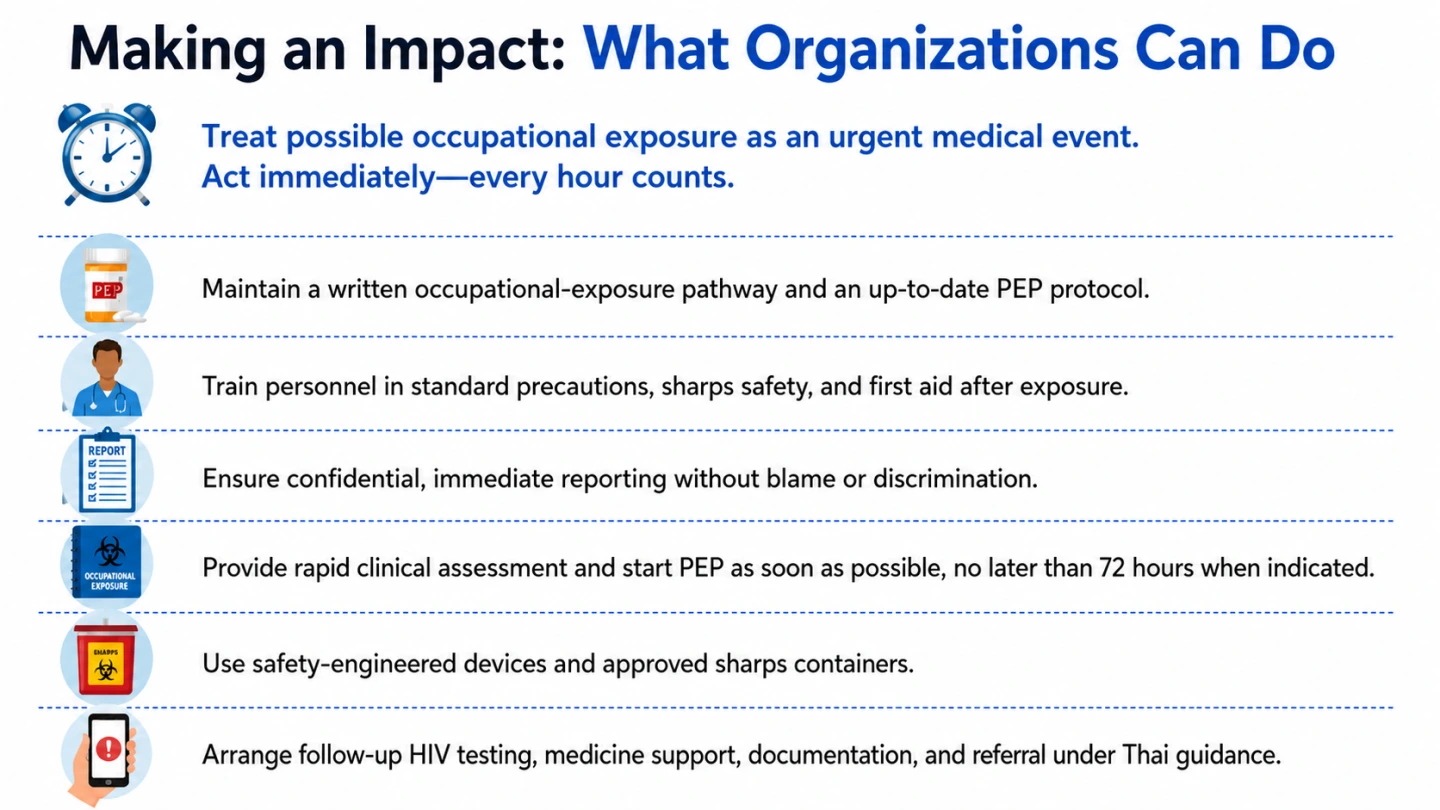
Needlesticks, sharps injuries, or blood splashes to eyes, mouth, nose, or non-intact skin require immediate, confidential assessment.
- Provide 24/7 assessment — PEP works best when started immediately and must begin no later than 72 hours.
- Maintain a written protocol — Cover first aid, reporting, source assessment, PEP access, and follow-up testing.
- Train and refresh staff — Teach prevention, safety-device use, and blame-free immediate reporting.
- Protect privacy and wellbeing — Limit access to records and provide a clear support contact for exposed staff.
Testing after PEP
Follow-up testing is necessary even if all tablets were taken and you feel well. Timing may differ with the test used, national guidance, concurrent hepatitis C, and any new exposure. Contact the service promptly if fever, rash, sore throat, swollen lymph nodes, or a viral-like illness occurs during or after PEP.
A new exposure during the course can change the end date and testing plan. People with recurring exposures should be offered a planned transition from PEP to PrEP without an unprotected gap.
How PEP differs from PrEP
| Question | PEP | PrEP |
|---|---|---|
| When? | After an emergency; start within 72 hours | Before a possible exposure |
| How long? | Usually 28 days | For the period that prevention is wanted |
| Best for? | A specific recent event | Planned prevention or recurring opportunities for exposure |
| Shared safety step | Confirm HIV status, use medicine as prescribed, and attend follow-up | |
Common PEP questions
It is almost 72 hours—am I too late?
Do not spend more time calculating. Seek care immediately. Earlier is better, and the clinician will assess the actual timing and exposure.
Can I buy a few antiretroviral tablets and treat myself?
No. PEP requires a complete regimen, baseline assessment, interaction review, and follow-up. An incomplete or inappropriate combination may be unsafe.
Does PEP prevent other STIs or pregnancy?
No. Emergency contraception, STI testing or treatment, and vaccination are assessed separately.
What to do during and after a PEP course
PEP is an emergency response, not a substitute for ongoing prevention. Take every dose for the prescribed course and keep follow-up appointments even if you feel well. Tell the service promptly about vomiting, missed doses, difficulty obtaining a refill, or another possible exposure. Do not stop because of a mild side effect without asking for help; many problems can be managed, while the clinician should urgently assess severe rash, breathing difficulty, jaundice, or other serious symptoms.
Follow-up HIV testing is needed because no test immediately after an exposure can rule out infection from that event. The service will select the test and schedule based on the exposure, the PEP regimen, and current guidance. They may also test or treat other STIs, assess hepatitis B vaccination, discuss emergency contraception when relevant, and offer support after sexual assault or an occupational injury.
Before the course ends, discuss what will protect you next. If exposure may continue, PrEP can often begin directly after PEP with appropriate HIV testing and clinical review. For occupational exposure, record how the event happened, follow the workplace pathway, and use confidential employee-health or specialist services. An exposure is a medical event that needs timely care, not a reason to blame the person who was injured.
The first assessment considers the fluid, route, tissue involved, timing, source information when available, and whether the source has sustained viral suppression. Do not delay care while trying to obtain another person’s test result or permission. Wash skin with soap and water, flush mucous membranes with clean water, and avoid caustic chemicals or squeezing a wound. A clinician determines whether PEP is indicated and checks kidney function, hepatitis status, pregnancy, interactions, and baseline HIV testing without using the baseline result to exclude a very recent exposure.
PEP medicines are generally prescribed for 28 days. Starting promptly matters more than waiting for a specialist appointment, and an initial supply can be reviewed as additional information becomes available. Keep the regimen with you, plan refills before weekends or travel, and ask what to do after vomiting or a missed dose. Emotional support, confidential reporting, and practical help with transport or cost can improve completion after occupational exposure, sexual exposure, or assault.
The person providing PEP should explain what the first HIV test can and cannot show. A negative baseline result cannot rule out HIV from an exposure that happened only hours or days earlier, which is why follow-up testing is part of the treatment plan. Antiretroviral medicines can also affect the timing of detection, so do not replace the scheduled blood tests with an unsupervised home test. Record the exposure date, first-dose time, medicine names, missed or vomited doses, and follow-up appointments. If fever, rash, swollen glands, sore throat, or another illness develops, contact the service and explain that PEP was recently used so the clinician can choose appropriate testing.
A PEP consultation should remain confidential, trauma-informed, and free of assumptions. After sexual assault, immediate safety, consent for each examination, forensic options, STI and pregnancy care, and emotional support should be offered without making access to PEP depend on a police report. After a workplace injury, reporting should trigger care and prevention review rather than punishment. For sexual or equipment-sharing exposure, clinicians should ask only the details needed to assess medical risk and ongoing prevention. When source information later confirms sustained viral suppression or shows that PEP is unnecessary, the prescriber can explain whether to stop; the person should not make that decision alone based on rumor or pressure from someone else.
- Take the complete prescribed course and contact the clinic before medicine runs out
- Attend every scheduled HIV test even when the first result is negative
- Ask about STI care, hepatitis vaccination, pregnancy prevention, and emotional support when relevant
- Plan PrEP or another ongoing prevention method before PEP ends if future exposure is possible