

How does HIV medicine work?
Antiretroviral therapy (ART) is a set of medicines you take together to stop HIV from making more copies of itself in your body. When the virus is held down, your immune system gets a chance to recover and grow stronger, so you get sick far less often. Doctors want you to start as soon as you know your result. Your doctor picks the right combination for you, based on your health history, other medicines you take, and how well your kidneys and liver are working.
ART holds the virus down, but it does not clear it out of your body completely. That is why you keep taking it for life. If you miss a dose now and then, follow your clinic's advice. Do not add or skip doses on your own. And if you notice side effects, tell your care team, because there is almost always a way to ease them or switch to a medicine that suits you better.
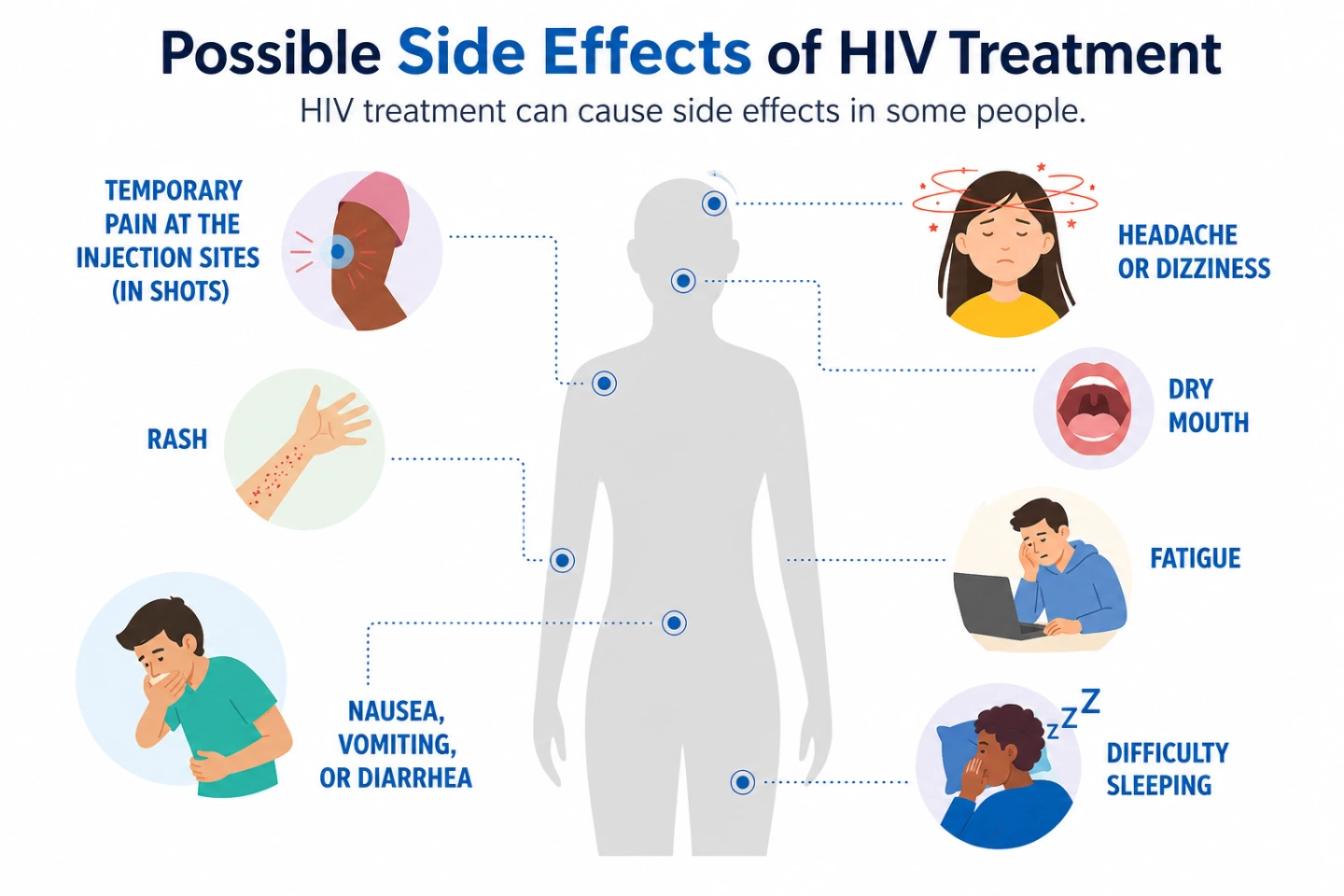
Not everyone experiences side effects, and effects vary by regimen. Many improve or can be managed with support from your care team.
- Nausea, vomiting, or diarrhea
- Difficulty sleeping
- Dry mouth
- Headache or dizziness
- Rash
- Fatigue
- Temporary injection-site pain with injectable treatment
What your blood tests check (viral load and CD4)
| Test | What it shows | What it's used for |
|---|---|---|
| Viral load | How much HIV is in your blood | See whether the medicine is holding the virus down |
| CD4 | The number of CD4 cells, which reflects immune status | Assess opportunistic-infection risk and guide care |
| Kidney/liver function | Whether these organs are still working normally | Check that the medicine is safe and no other illness is present |
| STIs/hepatitis | Whether you also have an STI or hepatitis | Treat them and plan full prevention |
What is U=U?
U=U stands for Undetectable = Untransmittable. In plain words: if you take your HIV medicine consistently until the virus is so low that tests can no longer find it in your blood, and you keep it that low over time, you will not pass HIV to a sexual partner. This is not a belief — it is proven by large studies and confirmed by health organizations around the world. U=U lets people living with HIV date and love with confidence, and it helps break down stigma.
U=U · Undetectable = Untransmittable — take your medicine consistently until the virus is undetectable and keep it there, and you will not pass HIV to a partner through sex.
Keep in mind that U=U only stops HIV from being passed on. It does not protect against other sexually transmitted infections (STIs) or pregnancy. It also only works while you keep taking your medicine and get your viral load checked as scheduled. If you have missed medicine for a while, or you do not yet know your latest result, ask your clinic about extra protection for now, such as using condoms.

A person living with HIV who takes treatment and maintains a viral load below 200 copies/mL will not transmit HIV through sex.
- Take ART as prescribed
- Check viral load as scheduled
- Maintain below 200 copies/mL
- Chance of sexual transmission
Long-term care
Looking after yourself well is about more than taking medicine. It also means getting enough sleep, eating well, staying active, caring for your teeth and mouth, quitting smoking, drinking less alcohol, getting the vaccines your doctor recommends, and caring for your mental health. And when you have a care team that listens without judging you, it is easier to keep your appointments and sort out problems sooner.
Take your medicine every day and keep your appointments to hold the virus down and track your blood results.
Look after the basics sleep enough, eat well, stay active, and care for your teeth and mouth.
Cut back on what harms your health stop smoking, drink less alcohol, and get the vaccines your doctor recommends.
Care for your mental health talk with a care team that listens without judgment.
When treatment needs review rather than interruption
A viral-load result, side effect, interaction, pregnancy, or another illness may prompt a treatment review, but it does not mean ART should be stopped without a plan. The clinic first checks how doses were taken, refill gaps, vomiting, other medicines, laboratory trends, and resistance history. A single low detectable result can be temporary; persistent rebound needs timely assessment. Changing all active medicines together under clinical guidance helps preserve future treatment options.
Tell every prescriber and pharmacist which HIV medicines you take. Acid-reducing medicines, mineral supplements, tuberculosis treatment, seizure medicines, some hormones, and herbal products can interact with particular regimens. Timing adjustments may solve some interactions, while others require a different medicine. Keep an updated list and ask before starting over-the-counter products. If you are admitted to hospital, make sure the team verifies the complete regimen so one component is not omitted.
Continuity also requires planning beyond the clinic visit. Request refills early, carry labelled medicine when travelling, and know who to contact after hours. If housing, work, transport, mental health, privacy, or cost makes adherence difficult, say so directly; social and community support can be part of treatment. The objective is durable suppression and a life that works for the person, not proving perfect behaviour at every appointment.
- Review a detectable viral load with the HIV team
- Check every new medicine or supplement for interactions
- Do not stop or split a combination regimen without clinical advice
- Plan refills and travel before the current supply runs out
Starting treatment: what the first weeks involve
Everyone with HIV should start medicine — you do not wait for your CD4 (immune level) to drop first. The sooner you start, the more it protects your health and stops HIV from being passed on. Many clinics can begin treatment the same day you get your result, after some baseline blood tests.
The best regimen is the one that works, is safe, and fits your daily life. No single pill is best for everyone; your doctor picks what suits you, based on drug resistance, other health conditions, other medicines, and any pregnancy plans. Ask how to take it, what to do if you miss a dose, and when your next viral load (amount of virus in the blood) check is. Never stop on your own without talking to the clinic.
- Baseline blood tests: viral load and CD4
- Resistance testing, kidney and liver function, and a hepatitis check
- Screening for tuberculosis, STIs, and pregnancy
- Tell your doctor every medicine, hormone, supplement, or substance you take
Adherence is a design problem, not a character test
Taking your medicine on time and consistently keeps the virus down and lowers the chance of resistance. Many things can get in the way — side effects, stress or depression, stigma, or simply forgetting. If you hit any of these, tell your care team early. There is almost always a way to help, and it is not your fault.
If you miss one dose, follow the label or ask a pharmacist — do not double the next dose on your own. If you miss several or stop for a while, go back to the clinic soon so your viral load and any resistance can be checked. For some people who are already well suppressed, a long-acting injection may be an option, but you still need to keep your appointments.
- Shift your dosing time to fit your life, or change the regimen
- Use home delivery, or pick up several months of medicine at once
- Set alarms, use a pill box, or ask a friend to remind you
- Care for your mental health, and get support for substance use if needed
Side effects, interactions, and long-term monitoring
In the first weeks you may have mild effects such as nausea, headache, poor sleep, or loose stool, which usually settle within two to three weeks. If they are severe or last a long time, get checked. Do not assume every symptom comes from ART — it could be another infection. If a medicine truly does not agree with you, the clinic can usually ease the symptom or switch your regimen.
ART can interact with some medicines — such as tuberculosis drugs, anti-seizure medicines, antacids, herbal products, and hormones — making treatment work less well or causing side effects. So every time you change doctor or clinic, share your full list of medicines. Over the long term, your team keeps an eye on your kidneys, liver, bones, heart, and mental health, plus vaccines, cancer screening, quitting smoking, and good food. These are core parts of care, not extras.
Life, relationships, family, and U=U
When treatment is going well, people living with HIV study, work, love, and raise families like anyone else. U=U means that if you take your medicine until the virus is undetectable and keep it there, you will not pass HIV to a sexual partner. Whether you tell anyone you have HIV is your own choice — weigh your safety and local law — and you can still use contraception or extra STI protection whenever you want.
If you are planning to have a baby, talk to your doctor about the right regimen and preventive medicine for the infant, because good care makes the chance of passing HIV to a baby very low. Older people living with HIV should pay extra attention to their heart, bones, kidneys, and memory. In the end, success is not just a number on a blood test — it is living with dignity and happiness.