Accessing PEP: Where to Go, Costs, and What to Know
PEP (post-exposure prophylaxis) is one of the newer ways to prevent HIV, meant only for people facing an emergency risk, such as a broken condom.
อ่านภาษาไทย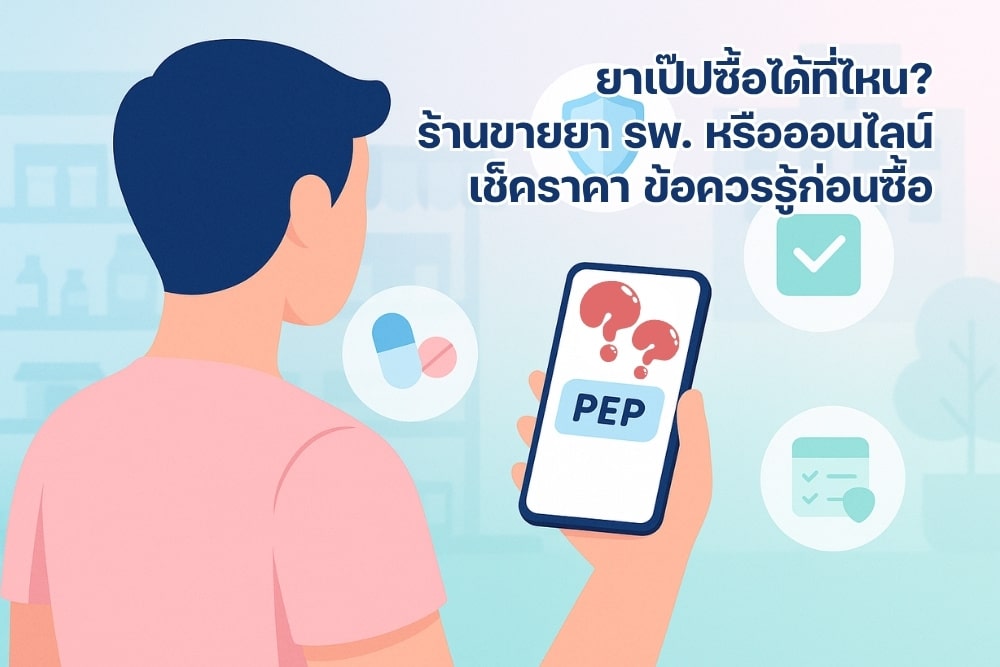
Contents
PEP is one of the newer ways to prevent HIV, and it is meant only for people who face an emergency risk, such as when a condom breaks, slips, or leaks, or is not worn during sex. It is also for people who share injection needles, people at risk through their work such as doctors or nurses who suffer a needlestick injury or are cut by a scalpel carrying the blood of someone living with HIV, and people who have been sexually assaulted or had sex while not fully conscious. As you can see, these are all unsafe, emergency-level risks.
Emergency HIV Medicine (PEP)
PEP stands for Post-Exposure Prophylaxis. It is an antiretroviral medicine taken after a possible exposure to HIV, an emergency treatment that must be started within 72 hours. This medicine works by blocking the replication of the HIV virus's genetic material before it can become a complete, mature virus, giving the body's immune system time to fight the virus before it spreads and damages the organ systems. You have to take it continuously so that the body maintains the right level of the drug. If that is hard to picture, it is much like the way a woman takes a birth control pill.
Who Should Take PEP?
- People who did not wear a condom during sex
- People whose condom tore during sex
- People who shared injection needles with others while using drugs
- People who have been sexually assaulted or had sex while not fully conscious
- People who had sex with someone living with HIV
- People who were pricked or cut by medical equipment
Where Can You Get PEP?
Of course, this type of medicine is a high-alert drug that requires a blood test and can only be prescribed by a specialist doctor. It cannot be bought at ordinary pharmacies or from online shops. You should contact a health facility, a public hospital, or a clinic that specializes in HIV and sexually transmitted infections (STIs) only, such as Hugsa Klang Wiang Clinic, Safe Clinic Bangkok, or Phuket Medical Clinic. The steps for getting PEP are as follows:
- A doctor or staff member will take an initial history of your risk. You should share your information and the details honestly so the doctor can clearly determine whether you need to take PEP.
- You will have blood drawn for tests, including an HIV test, a hepatitis B test, and liver and kidney function tests, to decide whether you can take the medicine safely. Importantly, PEP only works for people who do not yet have HIV.
- The doctor will tell you your blood test results, recommend the medicine that is right for you, explain how it works, how to take it, and its side effects, and dispense the PEP for you to take home.
- A nurse or staff member at the facility will schedule a follow-up appointment for you to be tested for HIV again once the required time has passed.
- You can start taking PEP right away, and if you have any unusual side effects, go back to see the doctor immediately.
How to Take PEP Correctly
Taking PEP correctly is what helps keep you safer from HIV. You should learn how to take it, or ask your doctor in detail, so that you understand how the medicine works. You need to take the full course the doctor prescribes, which is 28 days (some doctors may prescribe a few extra pills in case a patient forgets a dose or drops or loses some).
Take PEP on schedule and complete the prescribed 28-day course. If a dose is late or missed, follow the instructions for your specific regimen or contact the clinic or pharmacist; do not double a dose unless they explicitly direct you to do so. Take it on time, at the same time every day: for example, if you take it at 10 a.m., you should take it at 10 a.m. the next day. But if you truly forget, take it as soon as you remember. As for storing PEP, keep it at normal room temperature that is not too hot, and do not leave it in a car parked in strong sunlight, as this can cause the medicine to deteriorate.
How Much Does PEP Cost?
The PEP regimen differs from one facility to another, depending on the doctor's judgment about which regimen to choose for you. The cost is roughly 1,500 baht and up. We recommend calling ahead to ask. You can find more places to test for HIV and get PEP here.
Can PEP Be Taken Often?
In truth, PEP is quite safe to take, thanks to a regimen that medical research has developed to be more advanced. Even so, it is not a medicine meant for frequent use, or for taking every single time there is a risk of HIV, because it is fairly expensive and could lead to drug resistance in the future.
For people taking PEP for the first time, there may be short-term side effects when they start, such as dizziness, nausea, vomiting, fatigue, and a mild rash. These usually improve after about 1-2 weeks on PEP. If you have any other severe or unusual symptoms beyond these, go back to see the doctor right away.
When Is the Best Time to Take PEP?
Even though we stress that PEP should be taken within 72 hours, or no more than 3 days after the risk, realizing it early, seeing a doctor quickly, and starting the medicine right away is best. There is no need to wait 1-2 days before taking PEP, because the sooner you take it, the more fully and quickly the medicine can act against the virus, helping to stop the complete virus from growing in time and letting the body build immunity before the virus spreads. PEP is about 80-85% effective at preventing HIV.
As mentioned above, PEP should be taken as soon as possible once you realize you are at risk, and it must be taken under a doctor's care. While you are on the medicine, you should not donate blood and should avoid sex; or, if that is unavoidable, wear a condom every time. Choosing the right condom does a great deal to protect you from disease. Most importantly, do not forget to return for your follow-up appointments, because you will have repeat blood tests at 1 month, 3 months, and 6 months to confirm that you do not have HIV.
Read other interesting articles
- PrEP and PEP explained: are they the same or different?
- PrEP explained: how well does PrEP prevent HIV?
Verified references
Links and relevance to the article’s main topic were reviewed on 13 August 2026. Each source supports only the scope stated in the original document and does not replace personalised medical, legal, or service advice.
- CDC: Clinical Guidance for PEP Accessed 13 August 2026
- CDC: 2025 nPEP Guidelines Accessed 13 August 2026