Creating a Safe Zone for Life: The Physical and Emotional Safe Space Everyone Needs
"Safe space" has become a trending term again in 2022, especially within LGBTQ+ communities.
อ่านภาษาไทย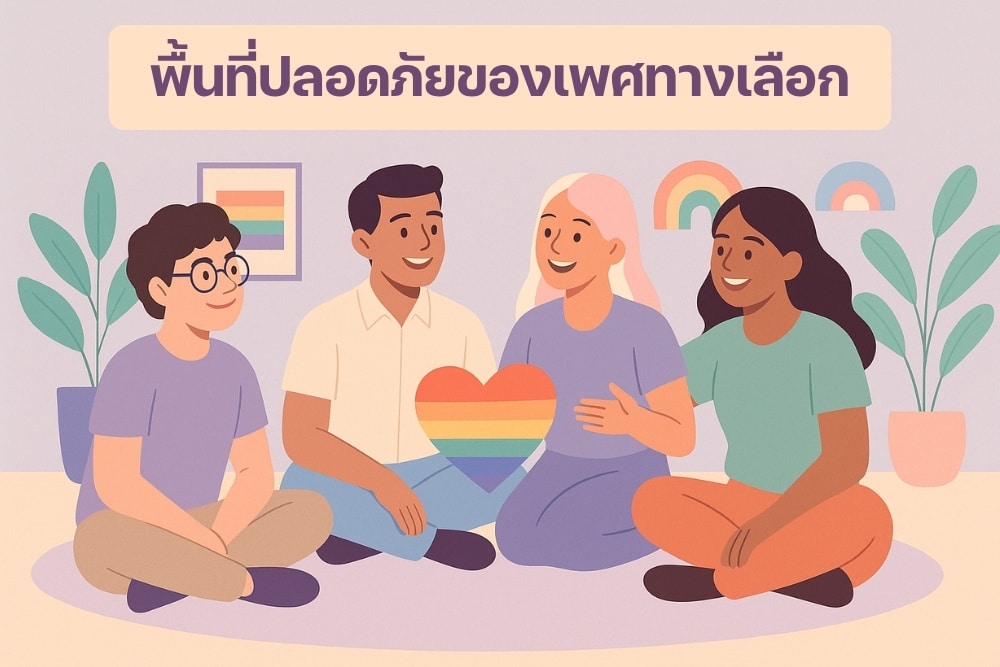
Contents
"Safe zone" has once again become a trending term in 2022, especially within LGBTQ+ communities around the world. In many countries, "safe zones" are taken so seriously that there are formal academic courses on the subject of "creating safe spaces" for both oneself and society.
The idea of a safe space has drawn just as much attention in Thailand, thanks in part to the LGBTQ+ influencer and advocate Khuean Pattaradanai Setsuwan, who has led a range of activities focused on creating safe spaces for everyone. Drawing on their own life, Khuean has shared their personal experiences and become another strong voice for LGBTQ+ people in Thailand, speaking to what they have lived through both in real life and online.
What is a safe zone?
We can define a safe space as a place where we feel safe from the judgment of outsiders, a place free from self-blame, and a place where we can listen to ourselves and be ourselves without being judged by others.
Why does a safe space matter for LGBTQ+ people?
"Coming out means giving up something in your life. If you reveal that you are LGBT, you may face pushback, people who don't support you, or people who dislike this kind of identity. It affects daily life. Working alongside colleagues who dislike you for being transgender or gay takes a toll, and sometimes it even affects your performance reviews, your pay raises, and your job promotions." Kru Kate (Kathawut Krangpiboon) said this in an interview with The Matter (thematter.co/social/lgbt-inequality-with-krukath/48901).
This quote shows that Thai society accepts LGBT people only conditionally, because many people lack an understanding of both gender identity and sexuality. Gender identity refers to a person's own sense of whether they want to be a man or a woman, or their sense that their outward gender can cross over to another gender. Sexuality refers to a person's romantic and sexual attraction toward others.
Gender identity and sexuality can align with each other, or they can be entirely separate. For example, someone may be assigned male at birth but be attracted to the same sex, or someone may be assigned male at birth but wish to transition to living as a woman while still being attracted to the opposite sex. All of these are possible. Worse still, the lack of understanding sometimes comes from within our own families.
As a result, safe spaces for LGBTQ+ people in Thai society seem to be shrinking. This can be seen in reports of violence against LGBTQNA+ people at the hands of their own families, because many parents expect their children to be a "mini me" of themselves, until it ends up harming everyone, both directly and indirectly.
When society and family do not understand what LGBTQ+ people choose to be, it becomes essential that each of us can be a safe space for ourselves. We can be at ease without needing anyone else to build that sense of safety for us, because we can be our own safe zone. In essence, a safe space consists of three things:
- Understanding yourself: understanding your identity, your perspective, and your true nature.
- Not judging: not weighing whether what someone does is worthy or unworthy, because it is that individual's own decision, and they are the one who bears responsibility for it. And most importantly of all:
- Listening: because so often we have people speaking but no one listening, even though every one of us can be both a good speaker and a good listener at the same time.
It might seem easy to create a safe space for yourself, by yourself. But is it?
Why can't many people have a safe zone of their own?
Because human society is not made up of ourselves alone, isolated from everything else. We are surrounded by people from birth, such as family, and by people who see the world differently and view us differently from how we see ourselves, such as classmates, university peers, bosses at work, or even strangers on the internet whose identities we don't even know.
Not everyone will listen, not everyone will hold back from judging, and not everyone will understand others; some may not even understand themselves. So the difficulty of creating a safe space arises because we don't all share the same level of understanding, and our compassion for one another is not the same.
"Does a safe space have to wait for someone else to create it, or can we be a safe zone ourselves?"
To tackle what looks like the hardest problem of all, we might start by understanding their lack of understanding. Once we recognize that their problem is that they don't understand diversity, that they don't see that the world isn't simply black or white, we stop giving weight to that shallow hatred.
Embracing the diversity of people is the foundation of living together in society. When we understand ourselves, who we are, what we want, and what we are doing, we can also understand our families, no matter how they understand us. As long as what they do does not intrude on or violate who we are, it need not be a problem, because we have already learned to accept ourselves. The same goes for a society that, much of the time, isn't really that interested in us anyway, much like getting on a public bus and passing countless strangers. Ask yourself whether you care about every single person you meet, and the answer is surely no. Give less weight to the people who don't understand us, and more value to ourselves, who understand everything that we are. When that happens, a safe space can arise from within us.
Read more interesting articles here
- GH Bank supports LGBTQ+ diversity: joint home loans for couples of any gender
- Why Pride Month matters
- South Korea's first lesbian pub and the movement for equality
Verified references
Links and relevance to the article’s main topic were reviewed on 13 August 2026. Each source supports only the scope stated in the original document and does not replace personalised medical, legal, or service advice.
- WHO: Mental health—strengthening our response Accessed 13 August 2026