South Korea's First Lesbian Bar: Lesvos and the Path Toward LGBTQ+ Equality
Lesvos Bar in Seoul became a refuge for LGBTQ+ people and a base for its owner's advocacy for anti-discrimination protections and equal rights in South Korea.
อ่านภาษาไทย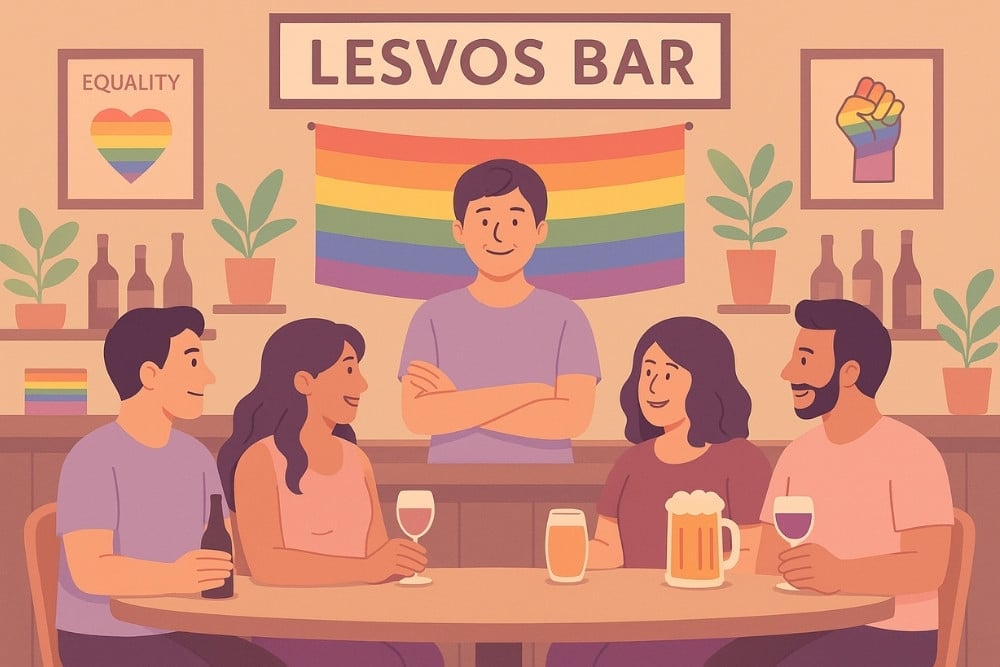
Even as South Korea keeps advancing in material wealth and technology, sexual rights, diversity, and equality have moved in the opposite direction and remained persistent problems. Many reports describe the harassment that arises when society refuses to accept diversity in how people live together.
In the Itaewon district of South Korea, there is one of the very few areas that is friendly to LGBTQ+ people. That community is known as Homo Hill, and it is home to the first lesbian bar in South Korea, opened back in 1999. Its owner, "Lesvos," runs the first and only lesbian bar in South Korea that welcomes the whole LGBTQ+ community.
Lesvos was born and raised in Seoul. At the age of 14, after she came out about being attracted to women, just as a classmate of hers was, her homeroom teacher sent her home and recounted the situation to her parents. That was the beginning of the discrimination she would face.
"They interrogated me, acting as if I had committed a crime, just because I said I liked women," Lesvos said. She was only 14 at the time, yet she met with discrimination both at school and at home. Lesvos was so frightened that she wanted to run away from it all, but she was still far too young to live on her own.
The years that followed were not easy. Between the ages of 20 and 30, she found herself isolated and misunderstood, and many times she lost the will to go on. She got through each day leaning on alcohol to soothe her mind, just to feel that she still had some worth and some reason to keep living.
Her story continued until she turned 40, in 1996. It was then that she came across a small gay bar in Seoul that welcomed everyone in the LGBTQ+ community. Lesvos was overjoyed to have found "friends" who understood her, and for the first time she experienced a culture and a gender diversity that came without conditions of any kind. That experience inspired her to save up her money and buy the bar for herself, giving both herself and the bar a new name: "Lesvos Bar," the only bar for people of diverse genders owned by a lesbian anywhere in South Korea. There, she too was reborn.
"I want this bar to be a place for every LGBTQ+ Korean, not just lesbians," said Lesvos, now 66. "It is my way of giving back to our community."
Beyond owning a bar that embraces gender diversity, Lesvos holds another admirable role: she is an activist for gender diversity in South Korea. Although South Korea is advanced in its values, culture, entertainment media, and a full-fledged democracy, a 2021 Gallup Korea Poll found that only 38% of the public supported a law allowing same-sex marriage, and discrimination is present everywhere.
In South Korea, national law offers no protection against discrimination based on sexual orientation or gender identity, and same-sex marriage and cohabitation are not legally recognized. LGBTQ+ students face constant discrimination at school. According to a recent Human Rights Watch report, same-sex couples cannot jointly adopt children, and in the military, consensual same-sex relations between service members are treated as a crime punishable by up to two years in prison.
When it comes to LGBTQ+ rights, South Korea is an outlier among the world's full democracies. In 2019, the Franklin & Marshall Global Barometer of Gay Rights assessed the 38 member countries of the Organization for Economic Co-operation and Development (OECD); only three countries earned a grade of B, meaning they were relatively friendly to LGBTQ+ people, while South Korea, Poland, and Turkey received a grade of F, meaning that harassment and discrimination based on sexuality remained fairly widespread.
Since 2007, members of parliament have introduced eight comprehensive anti-discrimination bills, but the country's president and conservative lawmakers have blocked them from passing in the National Assembly, even though a majority of the public (57%) supported an anti-discrimination law, according to a 2022 Gallup Korea Poll.
Lesvos says she will not be discouraged by such discrimination. The brownish-gray walls of Lesvos Bar are covered with rainbow pride flags, rally flyers, and copies of a bill handed to everyone who walks in: "Pass the anti-discrimination bill."
"Don't we have the right to live as equals?" Lesvos asked, her voice rising to its highest pitch. "I wish the word 'discrimination' didn't even exist. But no, it is real, and it is everywhere."
Although the path to passing an anti-discrimination bill remains hazy, Lesvos and the LGBTQ+ community still believe it can truly happen in the years ahead. Jang, a human rights activist and politician, believes the National Assembly will pass an anti-discrimination bill in the end. She does not know when, but she observes that most Koreans in their 20s support same-sex marriage, even though older generations still widely oppose it. In the end, she says, lawmakers will give way to the tide of the younger generation.
"And love will win."
With thanks for the information from: South Korea's LGBTQ community confronts crushing headwinds in fight for equality
Read more articles here
Verified references
Links and relevance to the article’s main topic were reviewed on 13 August 2026. Each source supports only the scope stated in the original document and does not replace personalised medical, legal, or service advice.
- OHCHR: LGBT rights fact sheet Accessed 13 August 2026