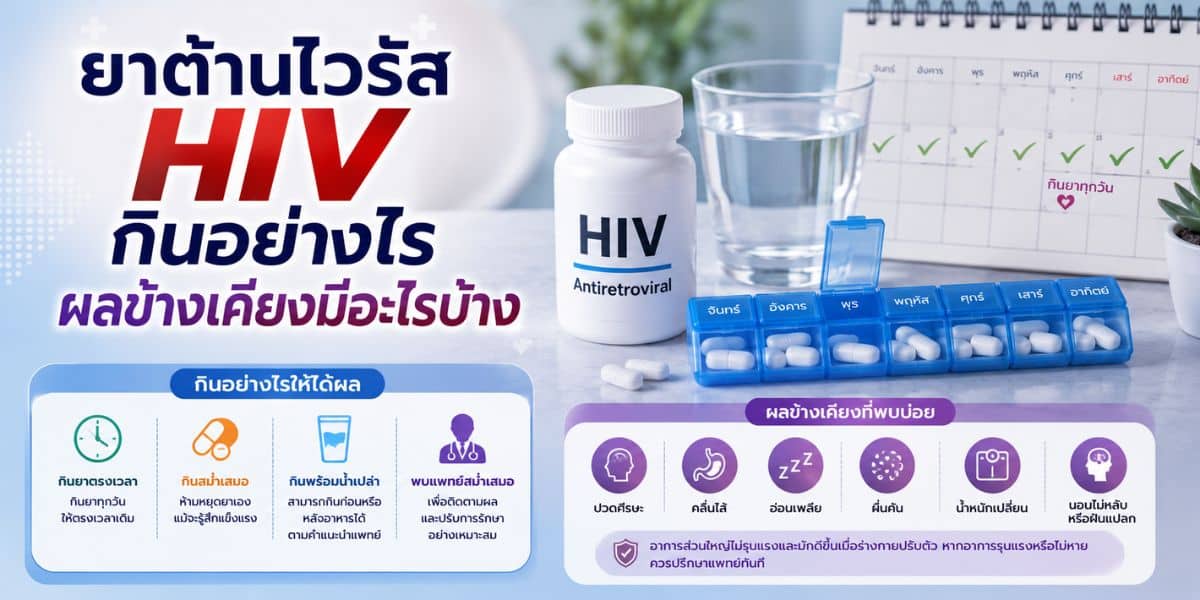
What Causes HIV? The Virus's Origin and How Infection Happens
HIV originated from SIV, a virus in non-human primates that crossed into humans more than a century ago.
อ่านภาษาไทย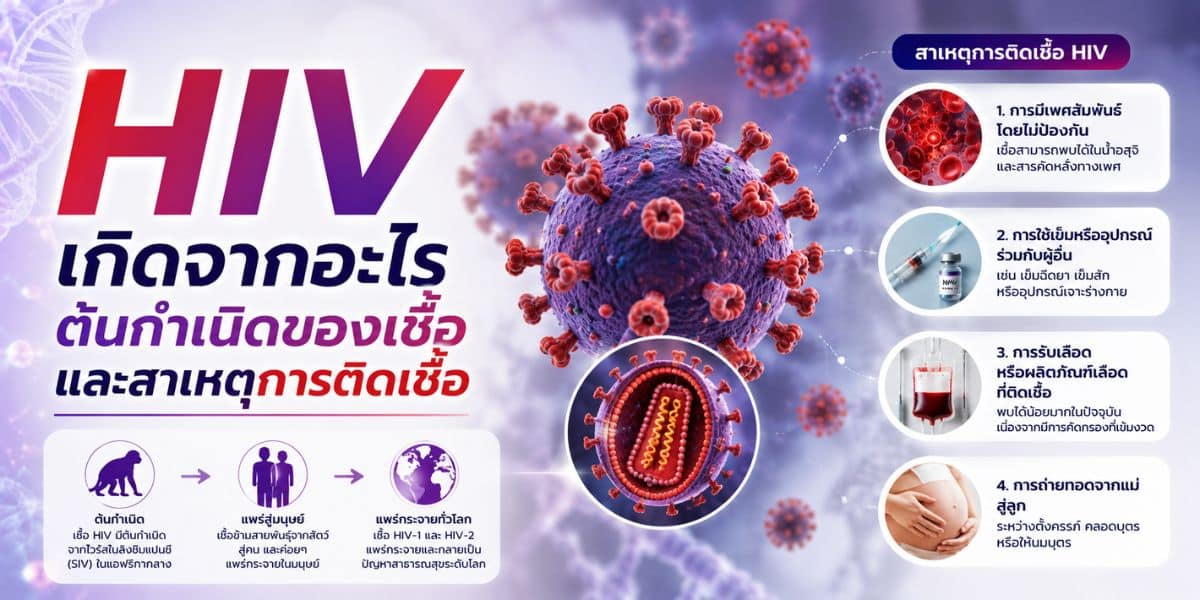
Contents
The question "What causes HIV?" has answers at three different levels, and the people who ask it are often looking for different levels of answer.
Some people ask because they want to know how they became infected themselves. Some ask because they want to understand what the virus does inside the body. And some ask because they wonder where this virus came from in the first place.
This article answers all three levels, and shows how the conspiracy theories still circulating in Thai society contradict the scientific evidence.
Level 1: How does a single person become infected?
At the individual level, HIV occurs when the virus from a person who has it enters another person's body, through just five body fluids.
- Blood
- Semen
- Vaginal fluids
- Rectal fluids
- Breast milk
And there must be a real route into the body — through a soft mucous membrane, an open wound, or direct injection into the bloodstream. For details, along with common misconceptions, see How HIV Is and Isn't Transmitted.
What does not cause HIV
This point is important enough to have its own heading, because the misunderstanding here causes people living with HIV the most pain.
HIV is not caused by being unclean, by any particular lifestyle, by sexual orientation, by karma, or by moral wrongdoing. It is a virus that does not choose whether someone is good or bad, just like hepatitis or influenza.
People living with HIV include those who had only one partner who did not know their own status, people who were assaulted, infants who acquired the virus from their mother, and healthcare workers who were pricked by a needle. Viewing this condition as "the result of behavior" is therefore both inaccurate and a direct obstacle to public health, because it makes people afraid to get tested.
Level 2: What does the virus do inside the body?
HIV is a retrovirus. It uses an enzyme called reverse transcriptase to copy its RNA into DNA, which can then become part of the DNA in a host cell.
The steps the virus takes
- Binds to a target cell — the virus chooses to attack a type of white blood cell called CD4 cells, which direct the entire immune system.
- Reverse-transcribes its genetic material — the virus uses an enzyme to convert its own RNA into DNA, the reverse of the usual flow from DNA to RNA, which is where the term "retro" comes from.
- Inserts itself into our DNA — this is the step that makes HIV so hard to eliminate, because the viral genes become part of our own cells.
- Directs the cell to produce new virus — the very cells that should be protecting the body instead become factories that produce virus.
- Gradually destroys CD4 cells — when CD4 falls low enough, the immune system becomes so damaged that opportunistic infections occur.
Step 3 is the reason there is still no complete cure, because some of the virus lies dormant in the cell's DNA without revealing itself, so neither the medication nor the immune system can see it. Read more at Can HIV Be Cured?
Level 3: Where did this virus come from in the first place?
HIV did not appear out of nowhere. It originated from a virus in non-human primates called SIV (Simian Immunodeficiency Virus), which has lived with non-human primates in Africa for a very long time.
How did the cross-species jump happen?
Genetic evidence indicates that the virus crossed from non-human primates to humans through direct contact with blood, which could happen in the context of hunting and butchering wild animals, when a hunter had a wound on their hand and came into contact with the blood of an infected animal.
What is important to understand is that this kind of cross-species jump is not unusual or alarming. Many viruses we know well all originated in animals, such as influenza, Ebola, and coronaviruses. This phenomenon has occurred periodically throughout human history.
A brief timeline
| Period | Event |
|---|---|
| Early 20th century | The virus crossed from non-human primates to humans in Central Africa. |
| First half of the 20th century | Slow spread within the region, following urbanization and transportation routes. |
| 1960s–1970s | The virus spread beyond the African continent. |
| 1981 | The first recognized cases of AIDS were reported in the United States. |
| 1983 | Scientists successfully identified the virus. |
| 1996 | Combination antiretroviral therapy turned this from a fatal disease into a manageable chronic condition. |
An important point that is often overlooked — the virus was present in humans for many decades before anyone knew about it, which explains why, when it was first discovered, large numbers of people were already infected across several continents.
How are HIV-1 and HIV-2 different?
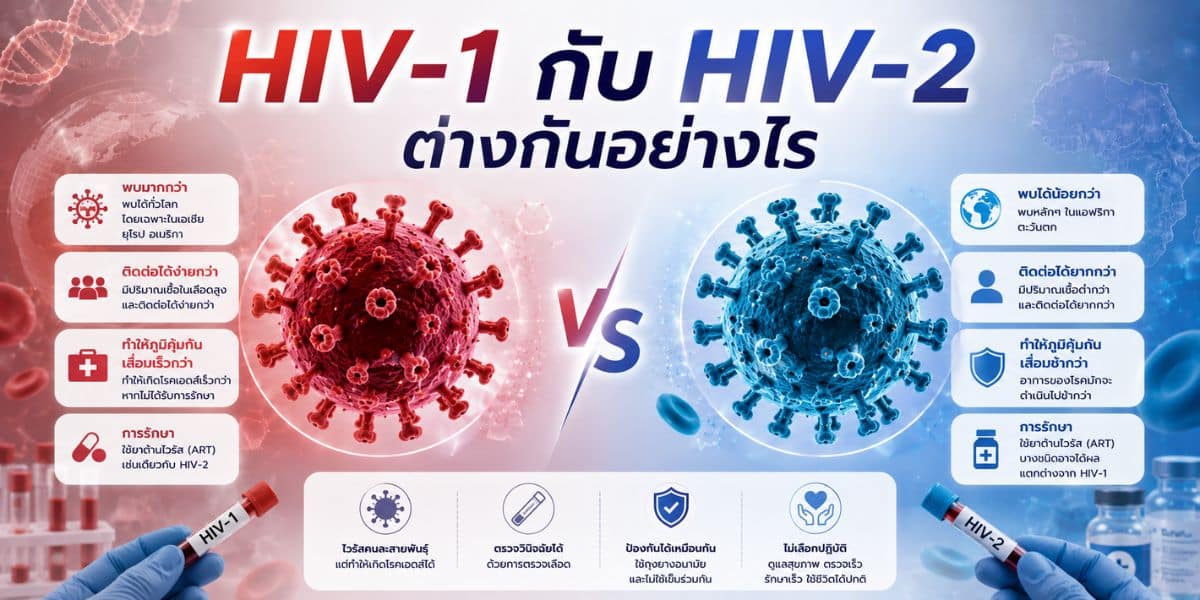
There are two main types of HIV, which came from two different non-human primate species.
| Aspect | HIV-1 | HIV-2 |
|---|---|---|
| Origin | Chimpanzees in Central Africa | Sooty mangabeys in West Africa |
| Distribution | Worldwide | Mostly in West Africa |
| Share of infections worldwide | Nearly all | A very small minority |
| Severity | Progresses faster | Progresses more slowly |
| Response to medication | Responds well to many drug classes | Naturally resistant to some drug classes |
HIV-1 accounts for nearly all infections in Thailand. Many diagnostic tests detect both HIV-1 and HIV-2, while choosing treatment for HIV-2 needs specific expertise.
Subtypes and the situation in Thailand
HIV-1 can be divided further into several subtypes, which are distributed differently across regions of the world.
In Thailand and the Southeast Asian region, the most common subtype is CRF01_AE, a recombinant subtype, while in Africa and Europe other subtypes predominate.
Points worth knowing:
- Subtypes do not change prevention — condoms, PrEP, and testing all work the same way.
- Treatment stays effective across subtypes — standard ART works across HIV-1 subtypes, though individual resistance testing and clinical factors still guide the choice of regimen.
- They matter for vaccine development — because a vaccine must cover this diversity.
- HIV superinfection is possible — superinfection means acquiring a second, different strain on top of an existing HIV infection, and already having the virus does not fully protect against it.
Why does this virus mutate so quickly?
The enzyme the virus uses to copy its own genetic material makes errors very frequently and has no proofreading system. As a result, every time the virus multiplies, it produces enormous numbers of copies that differ slightly from the original.
So in a single untreated person living with HIV, many different variants of the virus exist in the body at the same time.
This fact explains three things at once:
- Why several drugs must be taken together — to attack multiple points at once so the virus has a hard time finding a way to survive.
- Why taking medication inconsistently is dangerous — because it creates conditions that select for drug-resistant strains to survive. See Antiretroviral Medication and Taking It Consistently.
- Why there is still no vaccine — because the target keeps changing shape all the time, unlike a virus such as measles, which is fairly stable.
Conspiracy theories you should know are false
These beliefs are still widespread and cause real harm, because they lead people to refuse testing and treatment.
| Belief | Contradicting evidence |
|---|---|
| The virus was created in a laboratory | Retrospective genetic analysis indicates that the virus entered humans in the early 20th century, before genetic engineering technology existed. |
| HIV does not cause AIDS | A large body of research confirms the relationship, and it is clearly seen in the way people who receive antiretroviral therapy have their immune systems recover. |
| Antiretroviral drugs are what make people sick | People who do not receive the medication have clearly higher rates of illness and death. |
| Herbs can provide a complete cure | There is no evidence to support this, and stopping antiretroviral therapy to use alternatives leads to drug resistance. |
The impact of these beliefs is not abstract — in several countries, policies based on the belief that HIV does not cause AIDS have resulted in large numbers of people not receiving the medication they should have had.
How is knowing about the origin useful?
It may seem like an academic matter far removed from everyday life, but it actually has clear benefits.
- Reduces stigma — once people understand that this is a virus from animals that crossed species naturally, not anyone's "fault," their view of people living with HIV changes.
- Helps advance treatment — studying why some non-human primates can live with SIV without becoming ill is one avenue of research into controlling the virus.
- Prepares us for emerging diseases — the lesson from HIV is that a virus can spread quietly for decades before it is discovered.
- Builds resistance to misinformation — people who understand the evidence are not persuaded to stop their medication in favor of unproven alternatives.
Why do some people become infected less easily than others?
This is one of the topics research is most interested in, because it may lead to future treatments.
People with natural resistance
Some people have a genetic variation in the protein the virus uses as a gateway into cells, making it very difficult or almost impossible for the virus to enter.
This variation is rare and concentrated in certain populations, but it is scientifically very important. Several well-documented remission cases involved donors with the CCR5-Δ32 mutation, though remission has also been reported after a transplant from a donor with ordinary (wild-type) CCR5. Stem-cell transplantation is high risk and is not a routine cure for HIV. Read more at Can HIV Be Cured?
How long can the virus survive outside the body?
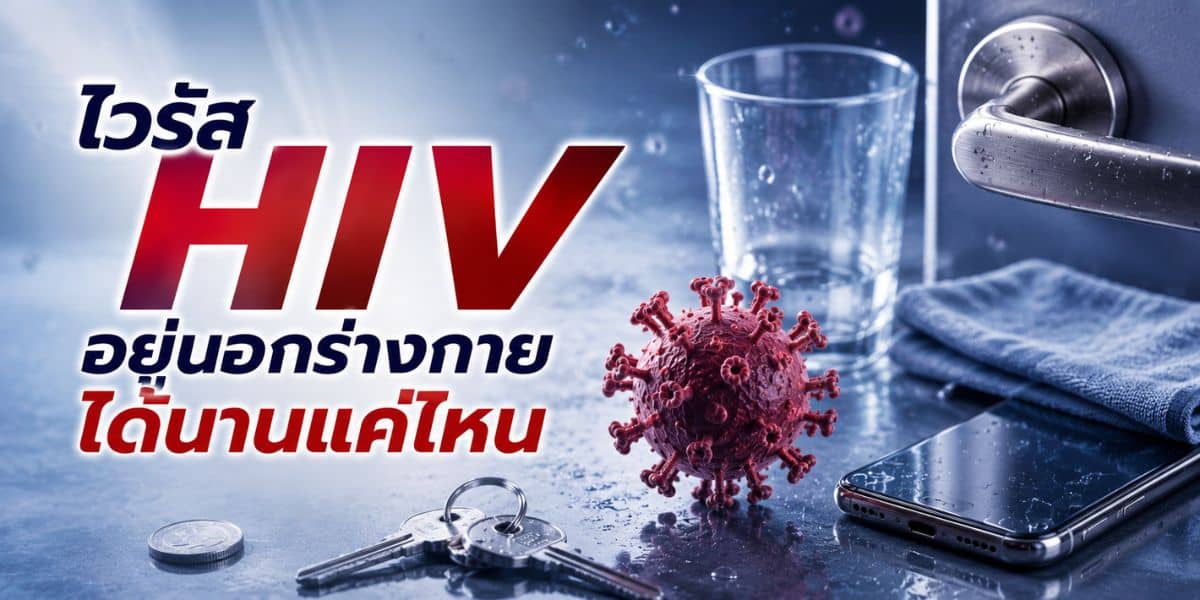
This question is at the root of many everyday fears — about a needle on the ground, blood on a table, or shared equipment.
The truth is that HIV is a very fragile virus when it is outside the body. It requires specific conditions to stay viable, and it rapidly loses its ability to cause infection when:
- It is exposed to air and begins to dry out
- The temperature changes
- The acidity (pH) changes
- It comes into contact with disinfectant, soap, or the chlorine in a swimming pool
This is the scientific reason that explains why sharing a bathroom, touching a door handle, sharing a towel, or swimming in the same pool does not transmit the virus.
The only exception to watch out for is a syringe with blood still left inside it, because the inside of the syringe barrel is an enclosed space where the blood has not yet dried — which is why sharing needles genuinely carries a high risk.
People who control the virus on their own without medication
There are a very small number of people living with HIV whose immune systems keep the virus at very low levels on their own for a long time without taking medication. Researchers study this group intensively to find out what enables their bodies to do this.
An important caution: the existence of this group does not mean that just anyone can control the virus on their own without medication. The overwhelming majority of people living with HIV need antiretroviral therapy, and stopping medication to "see whether the body can fight it off" is a risk that should never be taken.
Frequently asked questions
What causes HIV?
At the individual level, it results from acquiring the virus through the five body fluids entering the body. At the origin level, it comes from SIV, a virus in non-human primates, which crossed species into humans in Africa during the early 20th century.
Does HIV really come from non-human primates?
Yes. Genetic evidence shows that HIV-1 originated from chimpanzees and HIV-2 from sooty mangabeys.
Was this virus created in a laboratory?
No. Retrospective genetic analysis indicates that the virus entered humans before genetic engineering technology existed.
Which subtype is found in Thailand?
Mostly HIV-1, subtype CRF01_AE, which has no effect on standard prevention methods or treatment approaches.
Can you get HIV superinfection after already being infected?
Yes. HIV superinfection means acquiring a second, different strain on top of your existing infection, and already having the virus does not fully protect against it, so you should still use condoms.
Why is there still no vaccine?
Because the virus mutates so quickly that a vaccine cannot keep up. No HIV vaccine is currently licensed, and PrEP is an available and highly effective way to prevent HIV.
Summary
The shortest answer to this question is that HIV comes from a virus that originated in non-human primates and crossed into humans more than a century ago, then spread quietly around the world before anyone knew about it.
And the most important answer for anyone who is anxious right now is this — it is not caused by what kind of person you are. It is a virus with a clear route of transmission that can be prevented, detected, and treated.
Read on: Early Symptoms of HIV · How HIV and AIDS Differ · Thailand's HIV Treatment Guidelines
Book a free HIV test anywhere in the country at Love2Test.org
Verified references
Links and relevance to the article’s main topic were reviewed on 13 August 2026. Each source supports only the scope stated in the original document and does not replace personalised medical, legal, or service advice.
- WHO: HIV and AIDS fact sheet Accessed 13 August 2026