How Is HIV Transmitted — and How Is It Not? Saliva, Kissing, and Mosquito Bites
HIV is passed on through only five bodily fluids. Kissing, sharing meals, sharing a bathroom, and mosquito bites do not spread it.
อ่านภาษาไทย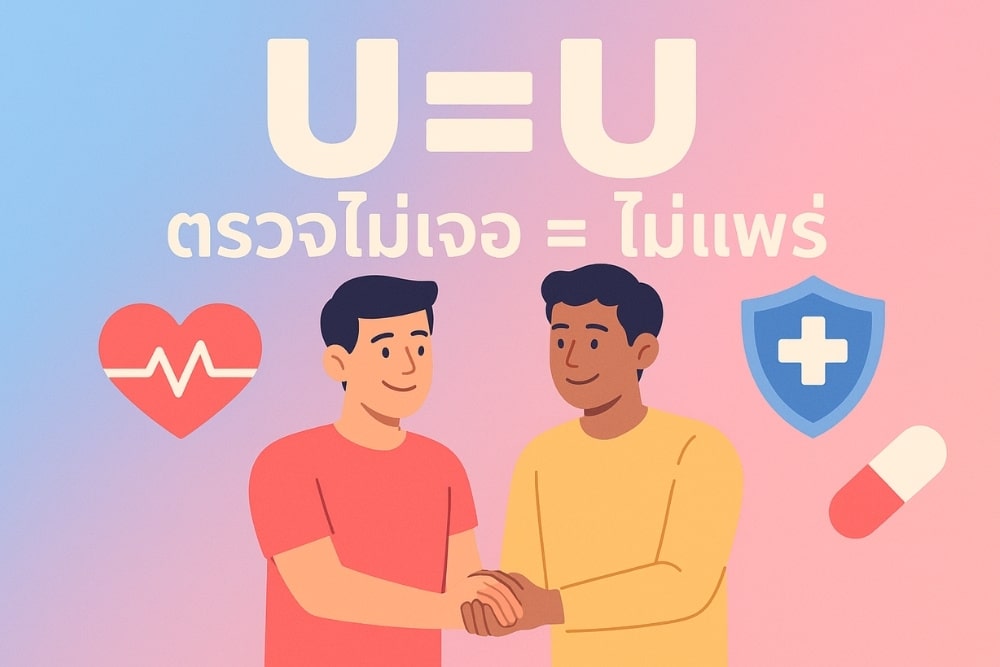
Contents
Most fear of HIV in Thai society does not come from real risk. It comes from misunderstandings about how the virus is transmitted. Many people lose sleep over sharing a meal with a friend living with HIV, while others have sex without a condom or another effective prevention method because they assume that "just once won't matter."
This article sets out clearly how HIV is actually transmitted, which routes carry no risk at all, and what science says about the questions people search for most — such as "can you get it from saliva?" and "how easily is it passed on?"
Four conditions that must all be present for infection
Before looking at each route, it helps to understand one principle, because it answers almost every question people have. HIV can only be transmitted when all four conditions are met at the same time. If even one is missing, infection does not occur.
- The virus must be present — the other person must actually have HIV, and their viral load must not be suppressed to an undetectable level.
- It must be a fluid that carries enough virus — only five fluids contain enough of the virus: blood, semen (including pre-seminal fluid/precum), vaginal fluid, rectal fluid, and breast milk.
- There must be a route into the body — through a soft mucous membrane (the anus, vagina, penis, or mouth), through an open wound, or by direct injection into the bloodstream. Intact skin with no cuts or wounds blocks the virus completely.
- The virus must still be alive — HIV does not survive long outside the human body, and ordinary environmental surfaces do not provide a route of transmission.
Almost every myth you are about to read fails on condition 2, 3, or 4.
Ways HIV can actually be transmitted
| Route | Risk level | How to prevent it |
|---|---|---|
| Anal sex (receptive partner) | Highest | Condom + lubricant, PrEP |
| Anal sex (insertive partner) | High | Condom, PrEP |
| Vaginal sex | Moderate | Condom, PrEP |
| Sharing needles to inject drugs | High | Use a new needle every time |
| Mother to child | High if untreated | Antiretroviral medicine during pregnancy |
| Receiving unscreened blood | Very high | National blood-screening system |
| Oral sex | Very low | Condom, dental dam |
| Needlestick injury in a healthcare setting | Low | PEP right away |
Anal sex
This carries the highest risk, because the lining of the anus is much thinner than the lining of the vagina and produces no natural lubrication, so small tears form easily — often without any pain. The receptive partner is at several times higher risk than the insertive partner.
Using a water-based lubricant together with a condom significantly reduces tearing, but it must be water-based or silicone-based only. Oil-based lubricants weaken condoms and can cause them to break.
Vaginal sex
The risk is lower than with anal sex, but this remains the main route of transmission worldwide. Factors that raise the risk include having another sexually transmitted infection (STI), vaginal inflammation, and having sex during menstruation.
Oral sex
The risk is very low — close to zero in ordinary circumstances — because saliva contains enzymes that inhibit HIV and the lining of the mouth is much thicker than the lining of the anus. The risk does rise, however, if there are sores in the mouth, bleeding or inflamed gums, or a recent tooth extraction.
With oral sex, the bigger concern is not HIV but syphilis, gonorrhea, and herpes, which pass on far more easily this way. Read more in the risks of oral sex.
Sharing needles to inject drugs
This puts the virus straight into the bloodstream, bypassing all of the body's natural defenses, so the risk is very high. It also includes sharing other equipment, such as syringes, cotton, or a spoon used to dissolve drugs. See harm-reduction guidance in safer injecting.
Mother to child
This can happen during pregnancy, during birth, or through breastfeeding. Today, however, it is almost entirely preventable: if the mother takes antiretroviral medicine during pregnancy, the chance of passing HIV to the baby drops to less than 1%.
Ways HIV is not transmitted — answering every myth
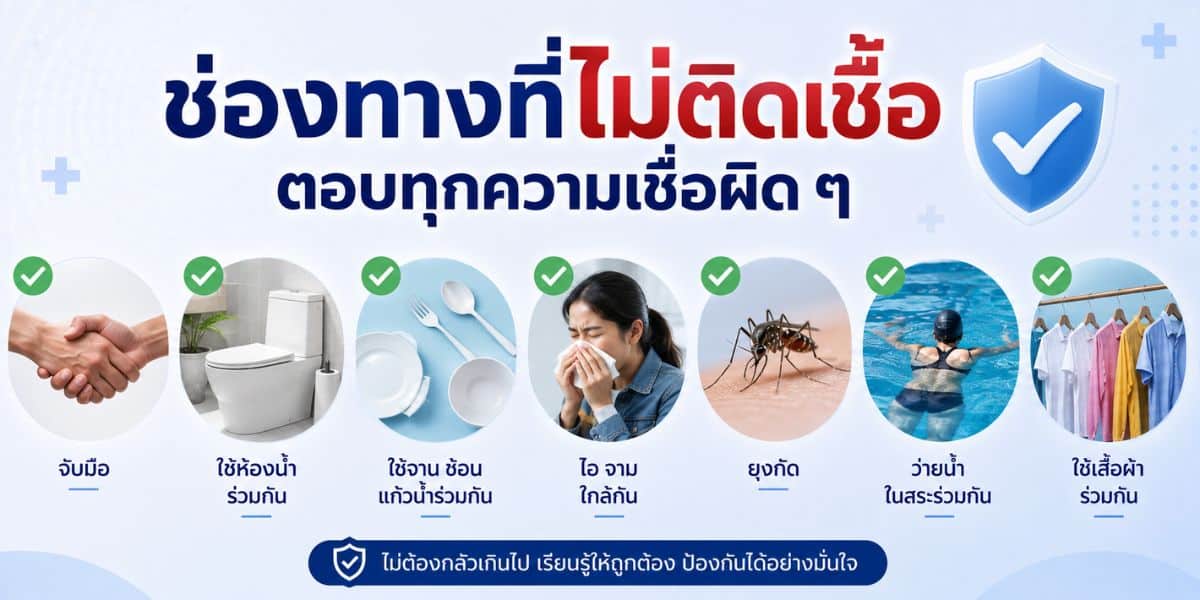
This is the most important part of the article, because these misconceptions are the root of the stigma that people living with HIV face in Thai society.
| Belief | Can you get HIV? | Why |
|---|---|---|
| Kissing on the mouth, exchanging saliva | No | Saliva contains far too little virus, and it has enzymes that inhibit HIV. |
| Sharing spoons, forks, or glasses | No | There is not enough virus in saliva, and it dies on contact with air. |
| Eating together from shared dishes | No | There is no route into the bloodstream. |
| Sharing a toilet or bathroom | No | HIV does not survive long outside the human body, and toilet or bathroom surfaces do not provide a route of transmission. |
| Swimming in the same pool | No | Chlorine and dilution destroy the virus. |
| Mosquito bites | No | The virus does not multiply inside mosquitoes, and a mosquito does not inject a previous person's blood into the next. |
| Shaking hands, hugging, touching skin | No | Intact skin is a barrier the virus cannot cross. |
| Coughing, sneezing, sharing a room | No | HIV is not a respiratory infection. |
| Sweat, tears, urine | No | These do not carry enough virus to cause infection. |
| Sharing towels or clothing | No | The virus does not survive on dry surfaces. |
| Working or studying together | No | There is no contact with risky bodily fluids. |
| Donating blood | No | A new, sterile needle is used every time. |
A closer look: why saliva does not transmit HIV
"Can you get HIV from saliva?" is one of the most searched questions. The answer is no, for three reasons.
- Very low viral load — even in someone with a high viral load in their blood, the amount of virus in saliva is far too low to cause infection.
- Saliva contains virus-blocking substances — in particular a protein called SLPI, which stops the virus from entering cells.
- No route in — a healthy, intact mouth lining is a strong barrier.
There is only one theoretical exception: deep kissing while both people have bleeding in the mouth at the same time, from wounds or severe gum inflammation. This is so rare that there are almost no medical reports of it.
A closer look: why mosquitoes are not carriers
This belief persists in Thai society even though it was disproved decades ago. The scientific reasons are:
- HIV cannot multiply inside a mosquito, unlike malaria or dengue, which use mosquitoes as hosts.
- A mosquito draws blood inward but injects its saliva — not the blood of a previous person — when it bites.
- The trace of blood left on a mosquito's mouthparts is far too small to cause infection.
If mosquitoes really were carriers, HIV would spread evenly across all age groups, including young children and older adults — which is not what real-world epidemiology shows.
"Is HIV easy to catch?" — the numbers to know
This is another common search, and the answer may be surprising: for a single exposure, HIV is harder to acquire than most people think. The risk builds up, however, with repeated exposures.
The figures below are estimates of the risk per 10,000 exposures, where the other person has HIV and is not taking antiretroviral medicine, based on CDC data.
| Type of exposure | Risk per 10,000 exposures |
|---|---|
| Receiving blood containing HIV | About 9,250 |
| Sharing needles to inject drugs | About 63 |
| Anal sex (receptive partner) | About 138 |
| Anal sex (insertive partner) | About 11 |
| Vaginal sex (receptive partner) | About 8 |
| Vaginal sex (insertive partner) | About 4 |
| Needlestick injury in a healthcare setting | About 23 |
| Oral sex | Too low to put a number on |
Don't misread these numbers. A risk of 138 in 10,000 may sound small, but it means that over 100 acts the cumulative risk becomes significantly higher — and in practice, plenty of people are infected from a single exposure.
What raises or lowers the risk
Factors that raise the risk
- A high viral load in the other person — especially someone recently infected and in the acute stage, when the viral load is highest and the person often does not yet know. Read about early HIV symptoms.
- Having another STI — sores from syphilis or herpes give the virus a much easier way in.
- Wounds or inflammation around the genitals
- Rough sex that causes tearing
- Being uncircumcised — raises the risk for the insertive male partner.
Factors that lower the risk
- U=U — if the other person takes antiretroviral medicine and keeps their viral load suppressed, they will not transmit HIV through sex at all. See Can HIV be cured?
- Condoms — highly effective at lowering risk when used correctly every time.
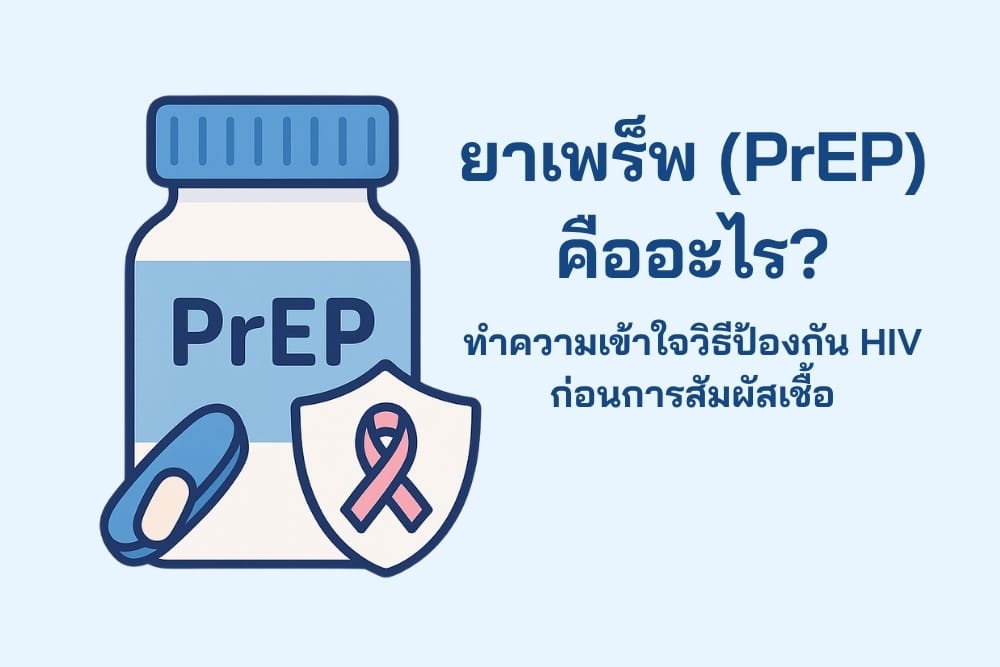
- PrEP — medicine taken before exposure that is highly effective at preventing HIV when taken as prescribed.
- Testing for and treating other STIs
How misconceptions cause harm
When people believe HIV spreads through sharing food or a bathroom, the result is not just personal fear. It means people living with HIV are shut out of workplaces, cut off by friends, or afraid to tell their families.
The knock-on effect is that many people are too afraid of stigma to get tested, so they start treatment late and may pass the virus on without knowing. Misconceptions, then, are not just a gap in knowledge — they are a direct barrier to public health.
Read more in supporting people living with HIV and HIV and human rights.
What to do after a recent possible exposure
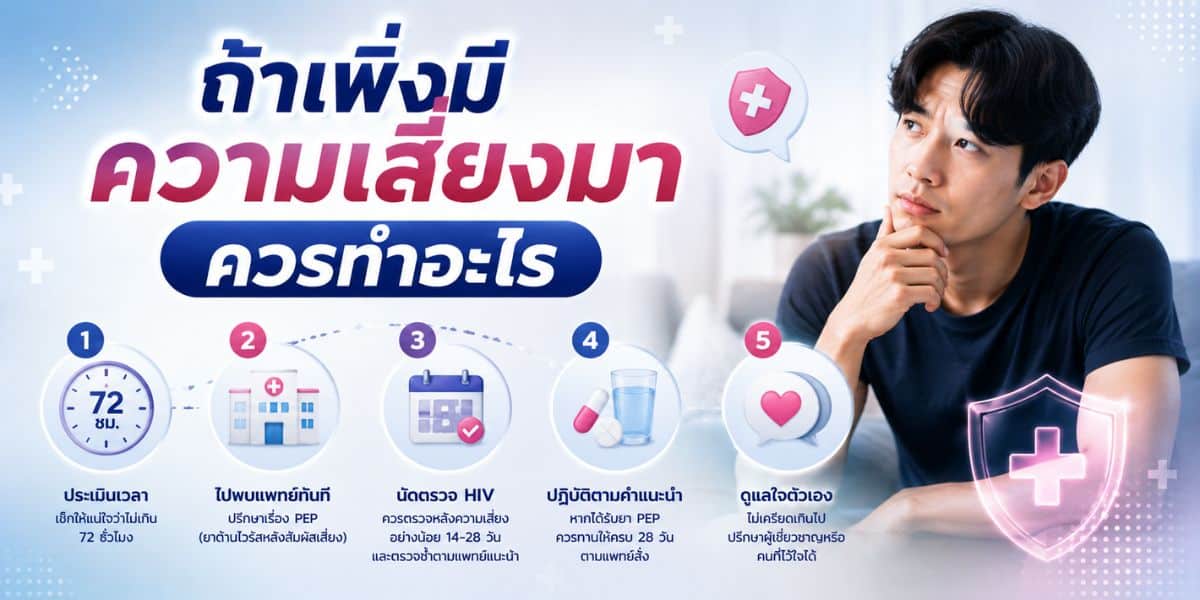
- Within 72 hours — see a doctor right away for PEP. The sooner you start, the better it works. Don't wait for symptoms.
- Don't douche or wash forcefully — rinsing out the anus or vagina after sex injures the lining and raises the risk instead.
- Plan your testing schedule — see the HIV window period.
- Protect your partner while you wait for results
- Test for other STIs too — see sexually transmitted infections.
Frequently asked questions
Can you get HIV from saliva?
No. Saliva contains far too little virus and has enzymes that inhibit it, so kissing, sharing spoons, or drinking from the same glass are safe.
Is HIV easy to catch?
For a single exposure, the risk is lower than most people think, but it builds up with repeated exposures — and yes, some people are infected from a single exposure.
If a mosquito bites someone with HIV and then bites me, can I get it?
No. HIV does not multiply inside mosquitoes, and a mosquito injects saliva, not a previous person's blood.
Can I get HIV from sharing a bathroom with someone who has it?
No. HIV dies quickly once it is exposed to air and to surfaces outside the body.
My partner is on antiretroviral medicine. Do we still need condoms?
As long as they achieve and maintain an undetectable viral load, they will not transmit HIV to you through sex while they achieve and maintain viral suppression through sex while they achieve and maintain viral suppression through sex while they achieve and maintain viral suppression through sex. Condoms are still worth using, though, to prevent other STIs and pregnancy.
Are dental work, haircuts, and tattoos risky?
The risk is very low if the business uses sterilized or single-use equipment. Choose a reputable place and make sure you see a new needle opened in front of you.
Summary
HIV is passed on through only five bodily fluids, and only when there is a genuine route into the body. Almost all everyday activities — from shaking hands, hugging, and sharing meals to sharing a bathroom or being bitten by a mosquito — do not transmit it.
The things that really matter are few: sex without a condom or another effective prevention method, sharing needles, and not knowing your own status — and all three can be managed with condoms, PrEP, not sharing needles (using new, sterile injection equipment), and regular testing.
Book a free HIV test anywhere in Thailand at Love2Test.org.
Verified references
Links and relevance to the article’s main topic were reviewed on 13 August 2026. Each source supports only the scope stated in the original document and does not replace personalised medical, legal, or service advice.
- WHO: HIV and AIDS fact sheet Accessed 13 August 2026