Same-Sex Marriage in Sikhism: Beliefs, Teachings, and Debate
Jasvir Singh, one of the most prominent Sikhs in British public life, is gay and married to a man.
อ่านภาษาไทย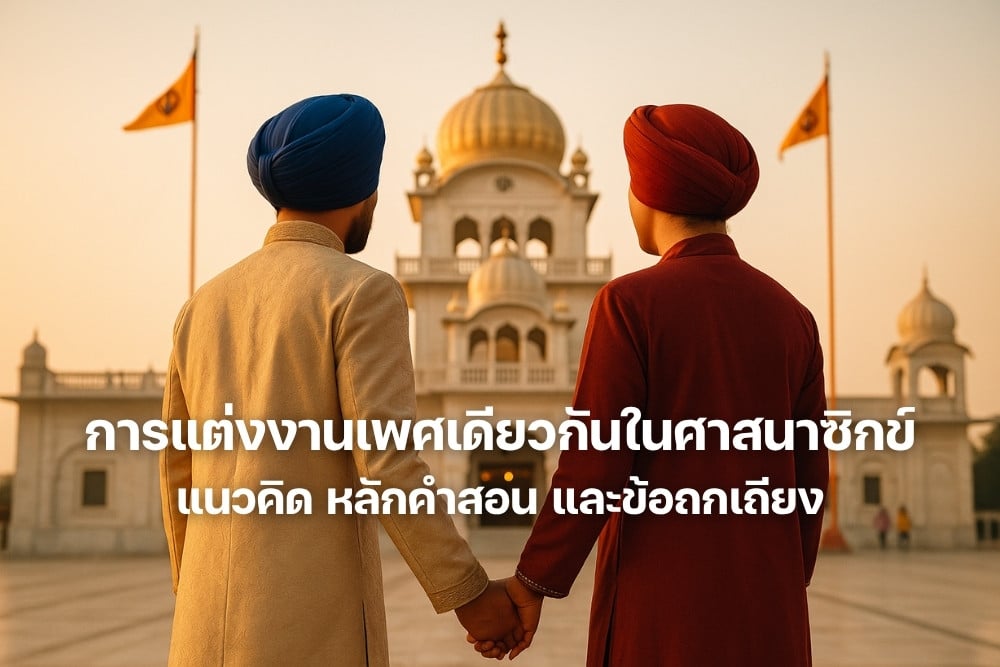
Jasvir Singh is one of the most prominent Sikhs in British public life, and he is also gay. Because he has largely kept his private life private until now and had not taken a public stance, he found himself at odds with some members of the LGBTQ+ community. But now he wants to speak about his sexuality.
A devout Sikh, married to a man
Jasvir Singh sets a photo on the table in front of him and takes a deep breath. It captures a happy moment from last summer, when he married his husband, Nick.
"I know that speaking about this is going to cause a great deal of conflict," he says. "I'm sure there will be plenty of people out there who will be upset, annoyed, or even angry with me. But I have nothing to hide, and I know that Waheguru [God] is with me, just as Waheguru has been with me all along my life's journey."
Jasvir is a family law barrister and a leading Sikh contributor to Radio 4's Thought For The Day. He was recently awarded a CBE for his work bringing people of faith together to support vulnerable communities. For years he has lived with speculation about his private life, which has often turned into attempts to intimidate him. But now he wants to speak about it openly and directly.
"There were incidents within the British Sikh community that were warning signs. I received death threats for being gay from them. I was accused on television of being a heretic who had left the religion, and some people phoned me and threatened to out me." Although Jasvir says he never tried to hide his sexual orientation, it was not something he had chosen to talk about publicly.
After a video from his wedding recently began to be shared on social media, he felt the time was right to speak out. He wanted to tell his story willingly and in his own time, to send a message to gay Sikhs who are struggling.
My Sikhism is a part of me, and so is my sexuality, and so is my turban, and so is my identity. I cannot separate any one of these from the rest of me. This is who I am.
Jasvir says the Sikhism he grew up with in his family placed great importance on the principle of equality, and he says he has never felt that his faith conflicted with his being gay. He points to a pivotal moment when he was 16.
"I was waiting for my GCSE results and travelled to India on a pilgrimage. My father and I journeyed for three or four days to a place called Hemkund Sahib, a beautiful gurdwara [Sikh temple] high in the Himalayas. After a hard journey, I paid my respects, but the one thing I prayed to God for was to be myself. I just wanted to live a life without having to feel ashamed, and without my family being ashamed of me."
Because his sexual orientation did not change after the pilgrimage, Jasvir began to feel that this was the path Waheguru had set out for him. It gave him the confidence to start going out and meeting people.
Although many Sikhs see it differently, Jasvir says he has never seen any conflict in the religion's teachings and scriptures between his faith and his sexual orientation. The Guru Granth Sahib, the central scripture of Sikhism, does not mention homosexuality at all, but it does speak of husband and wife. It also speaks of a divine spirit that pervades everything, and of seeing that spirit in every person regardless of race, caste, or gender. This leads Sikhs on opposing sides of the debate to point to the scripture as supporting their own position on homosexuality and same-sex relationships.
Recently, however, Jasvir says he has come up against an obstacle that is hard to overcome, one that means he cannot live out his faith in the way he wants to and in the way others are able to.
"My husband is a white Englishman who was not born into a Sikh family, but he understands my Sikhism, and he respects and embraces that part of my life. We had said we wanted to start a family and to raise our children as Sikhs. We talked in great detail about the wedding we wanted. But sadly, there is no way to marry in a gurdwara, even though in my interpretation of the Anand Karaj [the Sikh wedding ceremony] there is nothing that stands in the way of it."
Back in 2005, the Sikh religious leadership of the Akal Takht at the Golden Temple in Amritsar, in the Punjab, reaffirmed its position that same-sex marriage is unacceptable.
Gurmel Singh, Secretary General of the Sikh Council UK, which represents Britain's gurdwaras and Sikh religious institutions, says, "From the standpoint of faith, the ceremony remains firm and unchanged. The Anand Karaj is intended for opposite-sex couples only."
Gurmel Singh says he knows and respects Jasvir as a Sikh advocate, but that even in a rapidly changing society, the core teachings of the faith will not change to allow him to marry a man in a gurdwara. Jasvir, however, recalls a moment he read as acceptance from a senior Sikh religious figure, one that moved him deeply. It happened with his fiancé at a gurdwara in the UK before they married last year.
"We went to seek a blessing and to bring a rumalla, the cloth used to cover the scripture. The granthi who looks after the Guru Granth Sahib saw us come in together and said he would say an ardas [prayer] for us. He asked whether there was anything in particular we wanted him to pray for, and we said, for our wellbeing. But he asked whether we were really sure there was nothing else we wanted him to pray for. Then I realized he had noticed that we both had mehndi [henna] on our hands, which is usually done before a wedding."
"He said the ardas was not only for our wellbeing, but also for the coming together of our two families. It was incredibly powerful and moving for me, and for both of us."
Because most Sikhs trace their roots to the Punjab, Jasvir feels that the rulings issued by the faith's religious leaders have been heavily shaped by Punjabi culture rather than by scripture, though this is denied by the UK's Sikh authorities.
"Sadly, I know of gay Sikhs who have given up their faith, or who feel their only option is to cut their hair and become less observant, or to focus on an inner faith rather than spending time at the gurdwara."
Read other related articles
Although he leads a progressive Sikh organization in the UK, there are people in the religious community here who do not regard Jasvir as a truly observant Sikh, but rather as someone who wears a turban and follows only some aspects of Sikhism.
"My faith has been constant in my life, in good times and bad. I will not turn away from my beliefs, but neither will I be ashamed of my sexuality," Jasvir says.
Part of the reason Jasvir has spoken out is that, as he says, he never had gay Sikh role models, especially couples, or people who considered themselves observant in their faith. Yet he is well aware that he is privileged.
"It is sad, but I have seen Sikhs who came out to their families and were thrown out of their homes, beaten, called pedophiles, and had many other terrible things hurled at them," he says.
He says that in the UK, Sikh society is moving toward greater acceptance and understanding.
"When that wedding video was spread across social media with malicious intent, one of my elderly relatives found out that I am gay," he says.
"She is in her nineties, but she told other family members, 'As long as he is happy, I am happy.' That is something we can all learn from," Jasvir concludes.
Reference: BBC News
Verified references
Links and relevance to the article’s main topic were reviewed on 13 August 2026. Each source supports only the scope stated in the original document and does not replace personalised medical, legal, or service advice.
- OHCHR: LGBT rights fact sheet Accessed 13 August 2026