Thailand’s 2022 Civil Partnership Bill: A Historical Overview
This archived article summarizes Thailand’s 2022 draft Civil Partnership Bill, which the Cabinet approved to let same-sex couples register their relationship…
อ่านภาษาไทย
Contents
Historical note: In 2022, Thailand’s Cabinet approved draft civil-partnership legislation. This proposal was not the country’s current marriage law; it was later superseded by the Marriage Equality Act, which took effect on 23 January 2025.
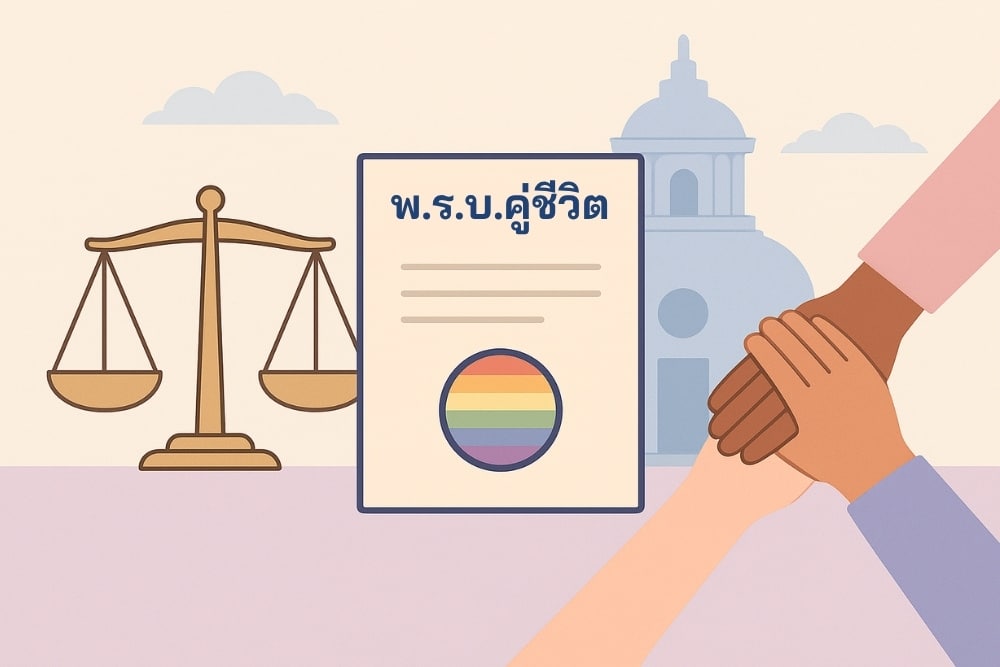
The Cabinet gave the green light to draft the LGBTQ+ Civil Partnership Act, which would let same-sex couples marry and register their relationship legally, strengthening families of diverse gender identities.
Key Points of the Draft Civil Partnership Bill
- A “civil partnership” means two people who are of the same sex by birth and have registered their partnership under this Act.
- The courts with jurisdiction over juvenile and family cases are given the authority to hear and decide cases under this Act.
- A civil partnership may be registered only when both parties consent, are at least 17 years of age, and are both Thai citizens or at least one of them is a Thai citizen.
- Where a minor wishes to register a civil partnership, consent must be obtained from the father, mother, adoptive parent, guardian, or the court; a minor attains legal majority upon registering a civil partnership.
- A civil partner has the same authority to act on behalf of an injured party as a husband or wife (Sections 3 and 5(2)), and the same authority to continue criminal proceedings on behalf of a deceased person as a husband or wife (Section 29, paragraph one), under the Criminal Procedure Code.
- Provisions are laid down governing the property of civil partners, dividing it into personal property and joint property.
- Civil partners may adopt a child, and one partner may register to adopt a minor who is the adopted child of the other partner as their own adopted child.
- When one civil partner dies, the surviving partner has the same rights and obligations as a spouse under the provisions of the Civil and Commercial Code concerning inheritance.
- The provisions of the Civil and Commercial Code concerning spouses (Sections 1606, 1652, and 1563), family, and adopted children shall apply to civil partners with the necessary modifications.
Key Points of the Related Draft Amendments to the Civil and Commercial Code
- A man or a woman may not enter into a marriage while they already have a “spouse” or a “civil partner.”
- The grounds for divorce are expanded to include cases where a husband or wife financially maintains or honors another person as a “civil partner.”
- The right to receive spousal maintenance (alimony) after a divorce shall cease if the recipient remarries or registers a civil partnership.
Ms. Ratchada added that, at the same time, the Cabinet approved the Ministry of Justice to conduct an assessment of the law’s effectiveness in accordance with Section 77 of the Constitution once the two draft laws take effect, and to work with other relevant ministries to study the impact and possible approaches to amending related laws.
Although this law is intended to protect the rights and obligations of civil partners fairly, equally, and without discrimination compared with the rights and obligations currently provided under the law, she said: “The draft Civil Partnership Act is a significant step for Thai society in promoting equality for people of all genders. It recognizes the right of same-sex couples to form a family.
It is also a legal instrument for managing family relationships, covering the registration and dissolution of a partnership, the rights and obligations between partners, the management of property, adoption, and inheritance, in order to strengthen families of diverse gender identities and to reflect present-day society.
It is also consistent with the goals of the National Human Rights Plan. For this reason, assessing and monitoring the two laws after they come into force is important and will lead to amendments to other laws to protect the rights of same-sex couples.”
With thanks to Khaosod for the information.
Verified references
Links and relevance to the article’s main topic were reviewed on 13 August 2026. Each source supports only the scope stated in the original document and does not replace personalised medical, legal, or service advice.
- ราชกิจจานุเบกษา: พ.ร.บ.แก้ไขเพิ่มเติมประมวลกฎหมายแพ่งและพาณิชย์ (สมรสเท่าเทียม) Accessed 13 August 2026
- OHCHR: LGBT rights fact sheet Accessed 13 August 2026