Russia’s Anti-LGBTQ Law: Its Impact on LGBTQ People and Freedom
Russia’s first queer museum has closed down under the country’s new anti-LGBTQ law, signed by President Vladimir Putin.
อ่านภาษาไทย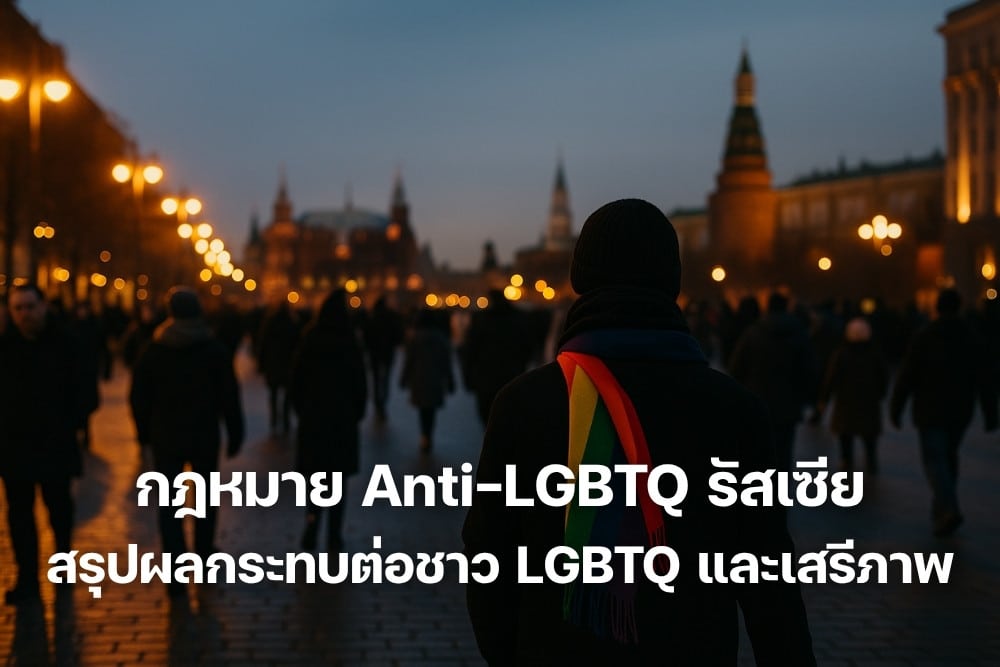
Contents
The first queer museum in Russia has closed down as a result of the country’s new anti-LGBTQ law. President Vladimir Putin signed the law on Monday, significantly expanding restrictions on activities seen as promoting LGBTQ rights in the country and forcing the museum to shut its doors.
Pyotr Voskresensky, an LGBTQ activist and historian from Saint Petersburg, opened a museum dedicated to LGBTQ culture on November 27. The museum held thirty objects — including statues, tableware, and books — that helped tell the harrowing story of Russia’s LGBTQ community. Under the recently approved anti-LGBTQ law, Voskresensky’s museum is considered illegal.
How will Russia’s new anti-LGBTQ law affect culture?
Voskresensky said, “I plan to send this collection abroad so that it can be exhibited independently, or together with gay museums in Europe.”
The law will bring major changes to Russia’s other cultural guidelines. It will affect online resources, as well as the production of theater, films, video games, books, and music festivals. It will also once again make the subject of gay sexuality a taboo in Russia, as it was long ago.
What anti-LGBTQ law was passed?
On Thursday, November 24, Russian lawmakers approved the final version of a bill that significantly expands restrictions on activities seen as promoting the rights of gay people in the country. The new bill is another step in the country’s years-long crackdown on its LGBTQ+ community.
The proposed law expands the ban on what authorities call “propaganda of non-traditional sexual relationships” to minors — a ban first established by the legislation nicknamed the “gay propaganda” law, which was introduced by the Kremlin in 2013 in an effort to promote “traditional values” in Russia.
This year, lawmakers moved to ban the dissemination of such information to anyone aged 18 and under. The bill was approved in its third and final reading on Thursday by the State Duma, the lower house of parliament. The law has been nicknamed the “Answer to Blinken” law, after U.S. Secretary of State Antony Blinken criticized it as “undermining freedom of expression.”
Vyacheslav Volodin, speaker of Russia’s State Duma, responded to Blinken’s comments:
“This is the best answer for the U.S. Secretary of State, Antony Blinken. Do not impose your alien values on us. Have you already destroyed your own values? We will see how it ends, but it will surely end sadly, because it is Sodom,” he said.
“You cannot call it anything else, and the United States has become the center of this Sodom in the world. Let them live there, but do not bother us,” Volodin added.
The law also expands existing restrictions by banning the dissemination of information about gender transition to minors, and by prohibiting information deemed to be propaganda promoting sexual relations with children. Violations are punishable by fines, and if committed by a non-resident, they may lead to detention and expulsion from Russia for 15 days.
A return to Soviet-style censorship and anti-LGBTQ policy
Russian book editors now find themselves facing growing censure, with new restrictions imposed on books produced by “foreign agents.” Booksellers will be required to hide controversial novels under plastic covers, so that the cover cannot clearly reveal that a book deals with LGBTQ themes — something Alexey Ilyin, founder of the Alpina publishing group, believes will affect the books that get published.
“Right now, most publishing houses will take this law into account when deciding whether to publish a new book,” Ilyin said. “It is very likely that they will drop this kind of book (BL novels), even if it is a bestseller,” he added. Russian publishers at a leading book fair in Moscow said they are “very concerned” about the new restrictions and fear the return of Soviet-style censorship.
Yevgeny Kopyov, from the large publisher Eksmo, said he is worried about the law’s “broad interpretation” of LGBTQ propaganda. He warned that it “could affect a great deal of literature, including the classics.”
“Everything will depend on our interaction with the regulators,” he concluded, noting that a law relying on people’s subjective judgment makes it hard to say what crosses the line, and by how much, at any given moment.
Many publishers like Kopyov are waiting for the authorities to clarify what they consider to be LGBTQ “propaganda.” But some bookstores in Saint Petersburg have already stopped selling “problematic” books, offering discounts of up to 50 percent, according to local media reports.
Read other related articles
Tatyana Stoyanova, brand manager at the publisher Kompas-Gid, said the restrictions could lead to a revival of the Soviet-era “samizdat” practice, which kept banned books circulating underground. “There is an idea in Russia that the more something is banned, the more interesting it becomes,” she said.
This may be another major step that freezes human rights and progress on gender diversity in Russia, raising fresh concern for LGBTQ people across the country. The law effectively signals to the public that, if a dispute arises between LGBTQ people and the general public, there is no doubt whose side the government will take.
Reference: EURO NEWS
Verified references
Links and relevance to the article’s main topic were reviewed on 13 August 2026. Each source supports only the scope stated in the original document and does not replace personalised medical, legal, or service advice.
- OHCHR: LGBT rights fact sheet Accessed 13 August 2026