HIV Gene-Editing: An Early Preclinical Study in Cells and Animal Models
In recent years, the concept of HIV treatment has advanced far beyond the use of ART (antiretroviral therapy) to suppress viral replication.
อ่านภาษาไทย
Contents
In recent years, the concept of HIV treatment has advanced far beyond the use of ART (antiretroviral therapy) to suppress viral replication. Targeting latent reservoirs—the hidden HIV inside human cells—remains one of the biggest challenges in HIV research. A new preclinical study from China has developed a targeted HIV Gene-Editing approach using engineered exosomes combined with CRISPR-Cas12a. Tested so far only in cells and animal models, it is an early-stage research approach that would still need much more safety and efficacy research before any human trials.
Globally, many countries—including Thailand—are closely monitoring the rise of CRISPR-based HIV therapies. This article explains the scientific meaning behind this breakthrough, its connection to modern medicine, and how this next-generation HIV Gene-Editing system could impact healthcare in Thailand if it progresses to real-world clinical use.
List of Contents
- An Innovation Precisely Designed to Target the Virus
- How the HIV Gene-Editing System Works
- A Safer HIV Gene-Editing Method
- What HIV Gene Therapy Could Mean for the Future
- Conclusion
HIV Gene-Editing - An Innovation Precisely Designed to Target the Virus
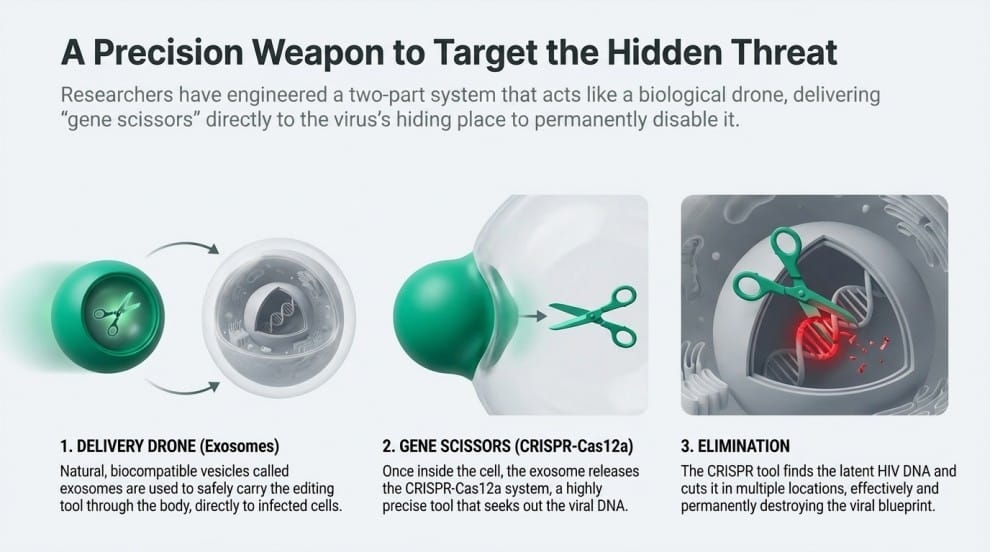
A research team from the University of Science and Technology of Wuhan, led by Gu Chaojiang, has developed a new delivery platform that uses exosomes to transport the CRISPR-Cas12a “gene scissors” into HIV-infected cells. Imagine a microscopic drone navigating deep into a hidden room, removing only its targeted object without damaging the structure around it—this is essentially how the new HIV Gene-Editing system works.
Key advantages of the new HIV Gene-Editing system
- Highly precise identification of viral DNA
- Enhanced safety—no need for high-dose viral vectors
- Ability to reach and disrupt latent HIV reservoirs
- Multi-site gene editing to prevent viral escape mutations
- Uses natural exosomes, making it more biocompatible
These features explain why this research has attracted significant global attention.
Why This HIV Gene-Editing Breakthrough Matters
Many may wonder why a new gene-editing method is such a big deal when gene-editing technology has existed for years. The answer lies in its ability to solve a challenge that the medical world has faced for over 30 years.
Major limitations of current HIV treatments
| Treatment Method | Advantages | Limitations |
|---|---|---|
| ART (Antiretroviral Therapy) | Suppresses viral load to undetectable levels; safe and widely used | Cannot eliminate latent HIV hidden in the nucleus |
| Immune Cell Therapy | Removes actively replicating cells | Cannot detect cells harboring latent HIV |
| Conventional Gene Therapy (AAV Vector) | Scientifically promising | Lacks targeting precision; risks toxicity |
To achieve a durable cure, researchers would need to clear latent HIV reservoirs—something no current treatment can do. This new HIV Gene-Editing approach is one early-stage research direction being explored toward that goal.
How the HIV Gene-Editing System Works
The HIV Gene-Editing system developed by Chinese researchers is designed to locate, target, and disrupt HIV DNA—both active and latent—inside infected cells. The process integrates advanced exosome engineering with CRISPR-Cas12a, creating a delivery mechanism capable of reaching viral reservoirs that traditional HIV treatments cannot eliminate. Below is a more detailed explanation of how each step works:
- Surface proteins are engineered so the exosomes can selectively bind to cell types commonly infected by HIV, such as CD4+ T cells.
- The exosomes encapsulate Cas12a safely, protecting it from degradation in the bloodstream.
- This ensures the gene-editing complex reaches the correct cells without causing widespread off-target exposure.
2. Delivering Cas12a into the Cell
Action: Once the engineered exosomes reach the infected cell, they fuse with the cell membrane and release Cas12a and its guide RNA into the cytoplasm.
What Happens:
- Cas12a is transported into the nucleus—the location where HIV has integrated into the host’s genome.
- The guide RNA (gRNA) directs Cas12a toward specific sequences found in HIV proviral DNA.
Outcome: Cas12a is now positioned at the exact site where viral DNA needs to be edited, fully prepared for DNA cutting activity.
3. Locating HIV DNA (Active + Latent Reservoirs)
Action: Using the gRNA blueprint, the system scans the host DNA for HIV sequences.
What Happens:
- Cas12a can recognize both actively replicating HIV DNA and latent HIV DNA embedded silently in the genome.
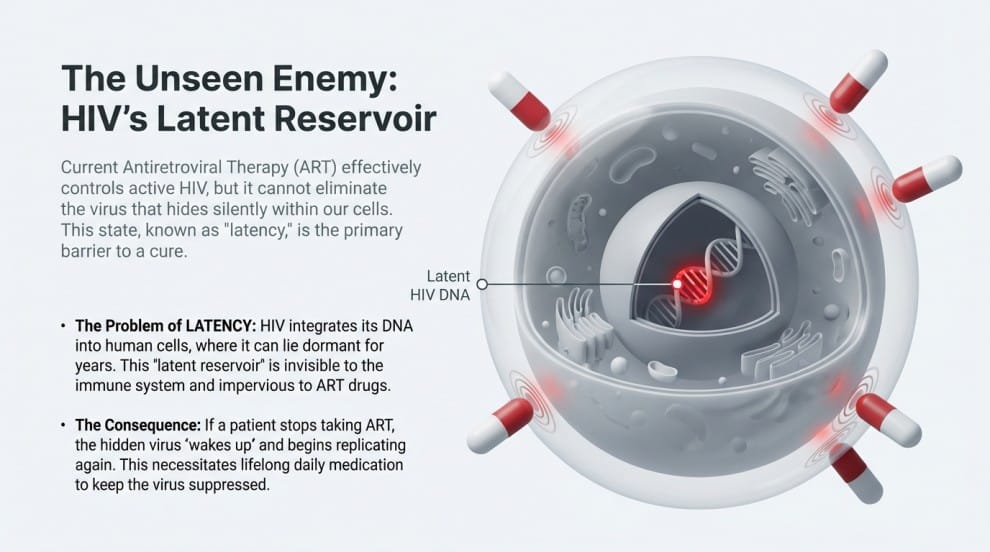
- This ability to detect latent HIV is crucial because these reservoirs are untouchable by ART and responsible for viral rebound when treatment is stopped.
- In the study's assays, the CRISPR-Cas12a system was designed to target HIV sequences; how its precision and off-target activity compare with Cas9 systems would need further study.
Outcome: Localization of HIV DNA, with the study reporting limited off-target editing in its assays—though off-target effects still need thorough evaluation.
4. Cutting HIV DNA
Action: Once bound to the viral DNA, Cas12a performs a double-strand cut, breaking the HIV genome into fragments.
What Happens:
- Without an intact genome, HIV loses its ability to replicate or reactivate.
- Multi-site editing can be performed, meaning Cas12a can cut several regions of HIV DNA simultaneously to prevent viral escape mutations.
- The cell's natural DNA repair mechanisms attempt to fix the break, but incorrectly repairing viral DNA leads to permanent inactivation.
Outcome: HIV enters a suppressed or non-functional state, significantly reducing or eliminating the viral reservoir inside the host cell.
5. Immune System Recovery
Action: With the viral genome disrupted, HIV can no longer hijack immune cells for replication.
What Happens:
- The immune system begins restoring CD4+ T-cell levels.
- Chronic inflammation associated with HIV infection decreases.
- The reduction in viral load offers the body a chance to rebuild immune function naturally.
Outcome: Significant reduction in viral load, improved immune markers, and potential progression toward a functional cure.
Evidence From Animal Studies
Animal trials demonstrated highly encouraging results:
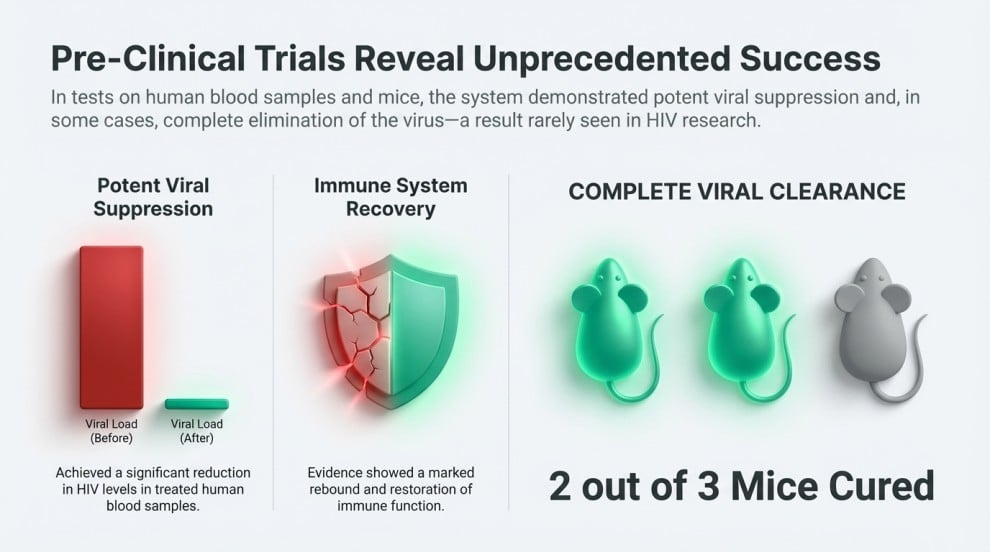
- Several mice showed a strong reduction in proviral DNA after the HIV Gene-Editing treatment.
- In one small study group, the virus became undetectable in two of three mice using the study's tests, though longer follow-up would be needed to know how durable this is.
- Treated mice also exhibited improvements in immune cell counts and overall immune function.
These early findings suggest that, with much more research, HIV Gene-Editing could become one approach for targeting latent HIV reservoirs—something no current HIV therapy can do—but this remains to be tested in humans.
Promising Results from HIV Gene-Editing Experiments
Tests in mice and in human cells studied in the laboratory (ex vivo)—no person received this intervention in the study—showed:
- Strong reduction in viral DNA after HIV Gene-Editing
- Improved immune function
- In one small group, the virus became undetectable in two out of three mice on the study's tests
Considering HIV’s ability to hide in human DNA for decades, achieving these results is an extraordinary scientific step forward.
Why Eliminating Latent HIV Matters
Latent HIV enters a silent, non-replicating state known as latency. ART cannot target this form. If treatment stops, latent HIV can reactivate and drive the virus to rebound.
The new HIV Gene-Editing system may be able to:
- Identify hidden reservoirs
- Cut HIV DNA directly
- Push the virus into long-term suppression (functional cure)
This is something ART cannot achieve.
Understanding HIV Structure and Its Relevance to Gene Editing
- HIV Envelope
- A lipid membrane that protects the virus and helps it evade the immune system.
- HIV Glycoproteins (gp120 & gp41)
- Act as keys allowing HIV to bind CD4, CCR5, or CXCR4 receptors—initiating infection.
- HIV Capsid (p24)
- Protects viral RNA and enzymes; dissolves after entry into the cell.
- HIV RNA
- The genetic blueprint used to create new viruses; converted into DNA inside human cells.
- HIV Enzymes
- Reverse Transcriptase: Converts RNA → DNA
- Integrase: Inserts viral DNA into human DNA
- Protease: Builds new mature HIV particles
 Overview: How HIV Works?
- HIV uses glycoproteins to attach to human cells → opening the entry pathway
- The capsid dissolves → releasing viral RNA and essential enzymes
- Reverse Transcriptase converts viral RNA into DNA
- Integrase inserts the viral DNA into the host cell’s DNA
- The human cell is then programmed to produce new HIV particles
- Protease processes viral proteins → assembling mature viruses that exit the cell and infect others
A Safer HIV Gene-Editing Method
Traditional gene therapies often require high doses, which increases toxicity. This new method uses exosomes, which are:
- Natural biological particles
- Less likely to trigger immune reactions
- Capable of specific targeting
- Small enough to penetrate tissues efficiently
These advantages are among the reasons researchers hope the approach could eventually be developed toward human trials—though it remains preclinical and unproven in people.
Looking Ahead: What Human Trials Would Need to Show
The researchers have pointed to human clinical trials as a future goal, but this remains preclinical work that has not entered human trials. Such trials, if they go ahead after further validation, would need to determine:
- Is the method safe for humans?
- Can HIV Gene-Editing work inside human tissues?
- Are there short- or long-term side effects?
- Is it effective across different stages of HIV infection?
If successful, this would mark a shift from simply suppressing HIV to genetically disrupting it.
What HIV Gene-Editing Could Mean for the Future
Potential Benefits
- A genuine possibility of functional cure
- Reduced reliance on lifelong ART
- Better immune restoration for advanced cases
- Adaptability for other viruses (e.g., HBV)
Challenges to Monitor
- Off-target editing risks
- Long-term safety
- Regulatory and ethical frameworks
- Real-world accessibility
- Next-Level HIV Control – Research from Johns Hopkins
- Innovations in HIV Medication – A Path Towards a Cure
Broader Medical and Social Implications
Even though the new HIV Gene Therapy approach is still in early development, its success in initial experiments has sparked global optimism. If proven effective, society may witness:
- reduced lifetime medication burden
- improved quality of life for people living with HIV
- lower long-term healthcare costs
- major progress in destigmatizing HIV
ART already transformed HIV into a manageable condition. But HIV Gene-Editing represents something far deeper a technology that could disrupt HIV at the genetic root.
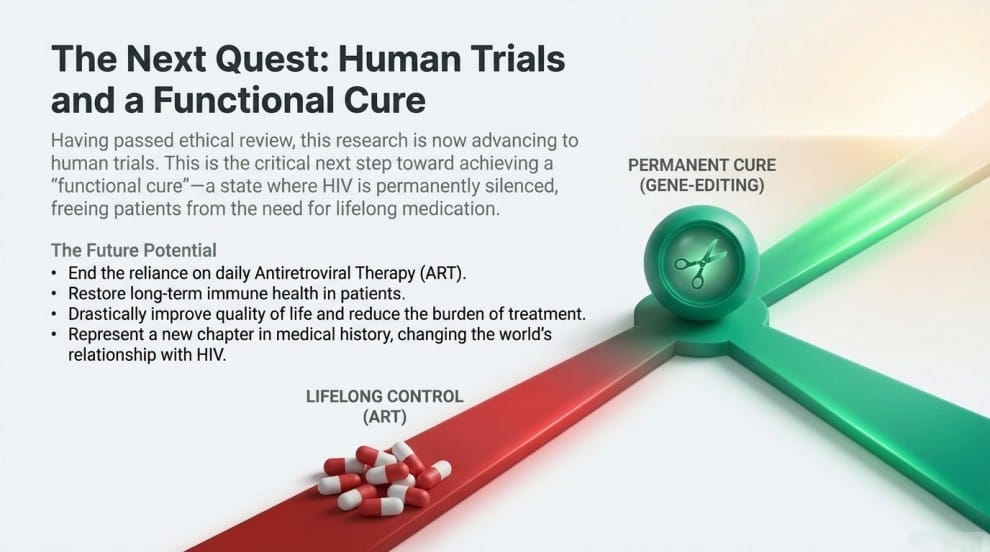
HIV Gene-Editing May Become a New Era of Treatment
This early-stage research points toward the long-term goal of a functional cure. An approach aimed at targeting latent reservoirs is a promising research direction, but it is still preclinical and has not been tested in people. Human trials would come only after much more safety and efficacy research; if future clinical studies were to validate it, the world might eventually see a new chapter in HIV treatment.
References:- Chinese researchers develop a targeted HIV gene-editing system that puts the virus into a dormant state
- From U=U to CRISPR: the future of HIV treatment you should know, and what we can do today
- Dr. Anan reveals good news: a UK company discovers a way to treat infected patients
Verified references
Links and relevance to the article’s main topic were reviewed on 13 August 2026. Each source supports only the scope stated in the original document and does not replace personalised medical, legal, or service advice.
- PubMed: EMT-Cas12a HIV gene-editing study Accessed 13 August 2026
- WHO: HIV and AIDS fact sheet Accessed 13 August 2026