LGBTQ+ Life in Thailand's Deep South: Journey, Rights, and Identity
Namfa Naphitchaya Phimphru, first runner-up at Miss Tiffany 2022, reflects on identity, discrimination, work, family, and LGBTQ+ life in Thailand's southern…
อ่านภาษาไทย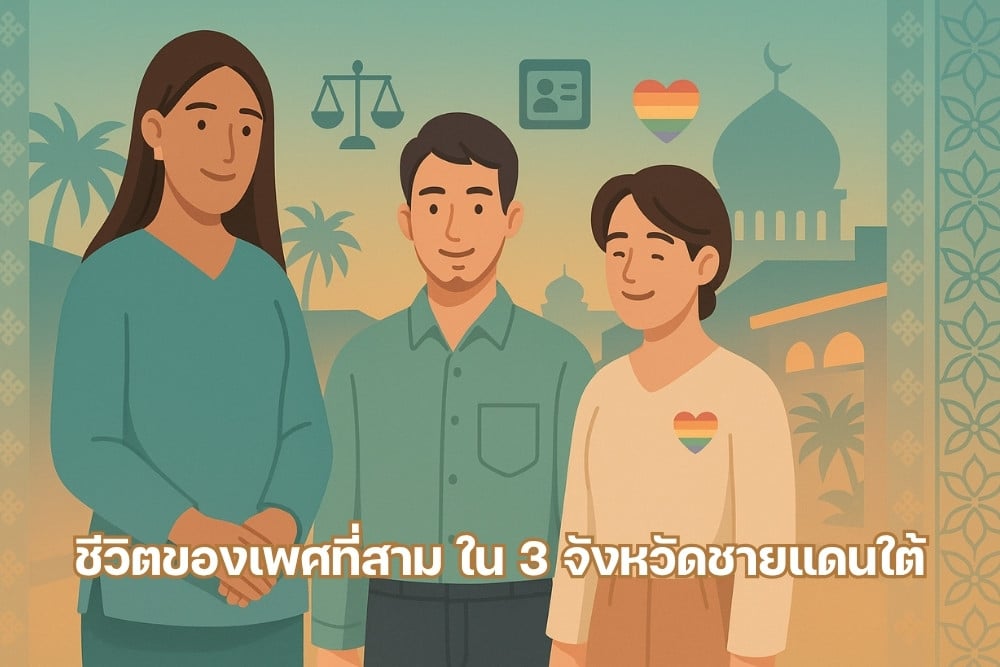
Contents
Although the hugely popular pageant for gender-diverse contestants like Miss Tiffany has wrapped up, there are still fascinating stories worth following from many angles. One of them, undeniably, is the response from Namfa, Naphitchaya Phimphru, who claimed the first runner-up crown at Miss Tiffany 2022 and stirred up a real buzz and interest in the lives of LGBTQ+ people in Thailand's three southern border provinces.
It echoes something she once said: "The soil of Pattaya, or the soil anywhere, is the same color as the soil of the three southern border provinces, so why should it be any different?" That key message she has spoken about before makes us want to know what, in reality, is the same or different about the lives of LGBTQ+ people in the three southern border provinces compared with elsewhere, and what Namfa wants to tell everyone as an LGBTQ+ person from Yala province.
Namfa's Interview
Q: Could you tell us about your life after growing up in the three southern border provinces? Is there anything that felt different to you, something that might not have happened at all if you had been somewhere else?
A: Most of my childhood wasn't much different from my friends in the gender-diverse community, because my appearance was still male. The real difficulty began after I started to change my appearance into that of a woman.
In this area, more than 80% of people follow a fairly strict faith, so anyone who lives differently has a hard time. Not just gay men or transgender women, but even a tom or a dee would find life quite difficult and restricted. While I was still studying I didn't see this clearly, because I felt I was following the rules in order to continue my education.
In fact, during my vocational diploma studies, I was lucky to meet a school administrator with real vision. He told me himself:
"You can dress as a woman or a man." He suggested I dress as a woman, but it was I who chose to dress as a man, so that he would know I could carry out my responsibilities.
I could be a good student, no different from anyone else. I'm also someone who likes to be active and energetic, so I thought a boy's uniform suited me better. The one thing I asked for was my hairstyle, because I had to keep my hair long for the pageant circuit at that time. That was another thing I paved the way on for the younger students, so they could keep their hair long, because a hairstyle has nothing to do with our dedication to our studies.
What Happened After Graduating and Starting Work
It was only once I started working that I ran into the differences and discrimination of a society with no clear rules and no fairness toward all kinds of diversity. We were given few opportunities. And "few" here doesn't just mean work or business opportunities. Even in social activities, volunteering, and public-service work, we were given a far smaller role.
Because of the label "not like others, different, an alternative gender who is neither man nor woman," many gender-diverse people here choose to build their lives elsewhere, because the social context doesn't allow them to thrive in their own hometown. It's a shame that we lose talented people from our own home simply because the environment doesn't truly understand them.
Once, I was hired to do makeup at our province's festival. With female clients there was no problem at all, but with some male clients there was panic, or they made it clear they didn't want me involved with them at all, even just to do their makeup. It was like asking for a different, female makeup artist, or asking outright whether they could skip the makeup altogether.
At that point I couldn't be sure whether they didn't want makeup because they genuinely didn't want it, or because it was me, the makeup artist standing there. And here the reactions could be quite harsh. Some would let me do their makeup but act irritated, and some would refuse bluntly and firmly.
Discrimination Toward LGBTQ+ People
Q: Have you faced discrimination in other situations too?
A: Back when I was getting my ID card before moving up to Bangkok, the official serving me had a brusque, gruff tone, a manner quite different from how they treated others, when they should have served us equally, like any other citizen.
Q: After you won your title, did anything change for you and in your local area?
A: After I returned to Yala, I was received more warmly. It was as if they were proud too that we had brought fame to Yala province. In the local area, I also took on cases referred to me by senior colleagues, doing more than just beauty work. Our help went beyond the gender-diverse community to include marginalized people, people with disabilities, and others in our society.
Q: When you meet fellow beauty-pageant friends or others who know you're from Yala or the three southern border provinces, how do they react?
A: Generally they show concern. At first we were glad of it; everyone kept asking after our well-being. But later it felt like it reproduced the stereotype of violence in the area, reinforcing the very events we'd lived through. That made us want to do away with the term "three southern border provinces" to lessen that stereotype.
"I want people to identify us clearly: Nong Fa from Yala Province, not Nong Fa from the three southern border provinces."
Q: And regarding hormone therapy, what was it like back then in the three southern border provinces?
A: I have to say it was very hard, both the information and the access to hormones. Back then, the first information I got was from an older woman next door, who suggested I try taking hormones to adjust my body. What I actually took was ordinary birth-control pills. It wasn't until I gained access to more information and grew older that I switched to hormones better suited to me.
These days the information is fairly easy to access compared with the past, but locally, access to hormones is still difficult because of a lack of public outreach. At first I was also anxious about my father. I knew that he knew, but I wasn't sure how much he could accept me changing myself. That's roughly how it was.
Q: Have you ever met gender-diverse friends who couldn't accept themselves?
A: Yes, I have. But do I understand them? I do. Given the context of their faith, what they wanted to be didn't align with their own beliefs. I once had a friend who was very close to me. We'd imagined transitioning and changing ourselves together. But in the end he decided to marry, have a family, and follow his own beliefs, that in the later part of life one should have a family to care for them and children to support them.
Before this, I once had a boyfriend who was a Muslim man. But in the end we had to part so that he could go back to the life he thought was normal and happy, in his own mind and in the context around him, living as "normal in his own way," with a family and children.
Q: Finally, if you could say something to the general public, what would you tell them? And what would you tell the gender-diverse community itself?
A: I'll split it into two parts. For the gender-diverse community, those who understand me, whether older or younger, please don't lose heart just yet. Everything has its time; let time be the proof. Before we can ask others to respect us, we must first respect others. And one day understanding will grow. If what we do harms no one, in the end society will understand us more. Do it, and keep moving forward.
Reflections on LGBTQ+ People and Society Today
As for the general public, at the very least, please don't judge us from the outside as wrong, as bad people, as sinners. I'd ask you to get to know us first. We can be doctors, we can be teachers, we can be nurses. We ask for only one thing: an opportunity from society. We want the chance to prove that we too can be everything society needs, and can be ourselves as well.
Read other related articles here
Verified references
Links and relevance to the article’s main topic were reviewed on 13 August 2026. Each source supports only the scope stated in the original document and does not replace personalised medical, legal, or service advice.
- OHCHR: LGBT rights fact sheet Accessed 13 August 2026