Chinese LGBTQ+ Voices: Shame After Coming Out and the Path to Self-Acceptance
Chinese LGBTQ+ people share personal stories of coming out, of the shame and stigma they face from family and society, and of their gradual journey toward…
อ่านภาษาไทย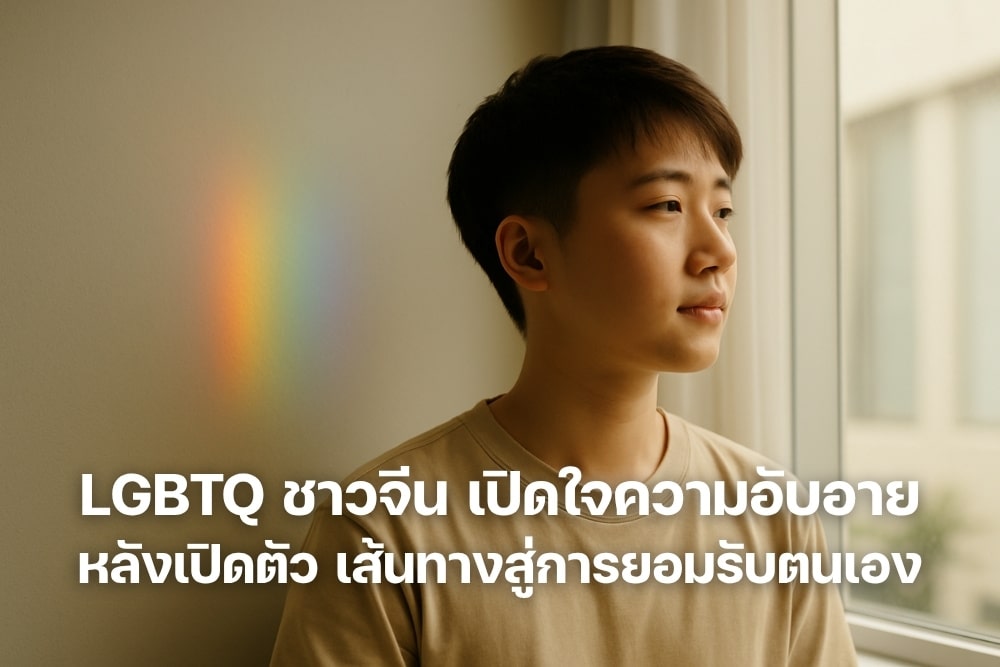
Contents
Ellen called their mother and asked her to take a popular quiz together over the phone. One of the questions was: "Do you think same-sex couples should have the same rights as opposite-sex couples, including the right to adopt children?" There was only silence. Then Ellen's mother asked, "Are you gay?" "Yes," Ellen replied — and then the line went dead. A moment later, Ellen received a message: "I'm sorry, but I can't love everything you are unconditionally. Our relationship as mother and child ends here." "When I saw that message, I felt like my whole life had fallen apart." This is what the 33-year-old Chinese international student told ABC's China Tonight.
Chinese LGBTQ+ People and Social Stigma
"I hid who I am." While studying at a school in central China, Ellen always knew they were attracted to women, but kept it secret. "Classmates who looked like 'butch lesbians,' or lesbians who presented in a more masculine way, would get bullied or mocked," they explained. "I didn't want to be seen that way, so I hid myself. I pretended to be normal, pretended to like men, pretended I wasn't gay."
At first Ellen came out as a lesbian, but now identifies as queer and prefers not to specify a gender. "I didn't realize I didn't have to be a woman. I tried to be the traditional Chinese woman society expected, but I couldn't do it," they said. "When I realized I didn't have to be a woman, I thought, 'I'm free.'" Years later, when Ellen went to visit their mother, "our relationship was quite cold," Ellen said. "I tried — I'd buy her flowers on Mother's Day and gifts on her birthday." Before long, the two started talking again, but the subject of Ellen's gender identity and sexual orientation became taboo in the family.
Gender Identity and Sexual Orientation Remain Taboo for Chinese LGBTQ+ People
"We're okay now," Ellen said. "She pretends not to know, and I pretend it never happened." Being queer and Chinese comes with challenges unlike any other. People in China's LGBTQIA+ community still face many legal, cultural, and social hurdles. Although homosexuality was decriminalized in China in 1997, sexuality and gender-diverse people receive very little legal protection from discrimination. Same-sex couples still face legal obstacles, such as being unable to marry or adopt children. By contrast, same-sex marriage has been legally recognized in Taiwan since 2019.
In recent years, Chinese authorities have suppressed issues that affect the community. Many LGBTQIA+ accounts on WeChat were blocked and had all their content deleted in 2021, and the country's largest pride event, held in Shanghai, shut down in 2020. Then there is the "flatmate," or roommate, phenomenon. Coming out can also mean facing shame from family and being stigmatized by society. Jackie knows this well.
In 2018, he came out as gay, but his mother reacted by refusing to accept it and hiding the truth from the rest of the family.
- Jackie's mother would tell relatives and friends, "My son isn't gay; he's still waiting for the right woman."
- "She lied about who I am," said the Hong Kong immigrant, who works in IT.
- Jackie believes that many Chinese parents, including his own, hold "old-fashioned views."
- "We're a Cantonese family, and having children is quite important to my family," he explained.
- "If you don't have children or don't get married, you bring shame to your family."
Jackie is now 27 and lives in Sydney with his boyfriend of five years, Ash. "A lot of Chinese LGBTQ+ people call their partners 'flatmates,'" Jackie says. "That's how they explain their relationship to their parents. We pretended like that for a while, but eventually my mother found out and was very hurt." Yet whenever Jackie's mother visits from Hong Kong, his boyfriend has to stay out of sight. "He's kind and very patient, but he's saddened that we barely get to see each other during those times. It's not good for our relationship," Jackie said.
Jackie describes coming out as an ongoing act of perseverance. "You keep coming out — to your friends, to society, to your family, over and over," he says. "My mother still doesn't accept me for who I am, but I hope that one day she will."
A Journey Toward LGBTQ+ Self-Acceptance
Jingmei is a 19-year-old nonbinary dancer. When they were young and living in China, Jingmei knew they were not "an ordinary girl." "I dressed like a boy and liked being around boys," they said. Jingmei moved to the United States in grade 10 and met a queer classmate in their German language class. "They came up to me and asked what they should call me," Jingmei recalled. "It was the first time I'd ever been asked something like that... I was confused and didn't really understand what they meant."
"I thought I wasn't an ordinary boy or an ordinary girl — I was just myself." Jingmei says dancing helped them understand and accept their identity and their gender. "I used to strongly resist embracing the more feminine parts of my body," they explained. But friends encouraged them to try different dance styles, including more feminine ones like waacking and voguing. "I still look beautiful," Jingmei said. "In the end, I came to accept my body and my femininity."
At 16, Jingmei had a partner and decided to come out to their mother. "She didn't understand at first," they said. "She thought I was too young and just joking, so she didn't take it seriously." But the more Jingmei learned about gender and sexuality, the more they talked things through with their mother, and the two came to understand each other better. "And now my mother and I are very close," they said. "She feels that because I'm her child and she loves me, she accepts me completely, no matter who I am."
Jingmei knows their coming-out story is not the norm. "For many nonbinary people like me in China, coming out can be hard. Their families or parents may not support them," they said. "My mother's love and acceptance have had a huge impact on me."
Read Other Related LGBTQ+ Articles
- The Global Legal Landscape for LGBTQ+ People
- Marching for the Rights of Transgender Youth and Gay People
Verified references
Links and relevance to the article’s main topic were reviewed on 13 August 2026. Each source supports only the scope stated in the original document and does not replace personalised medical, legal, or service advice.
- OHCHR: LGBT rights fact sheet Accessed 13 August 2026