Syphilis: Testing, Treatment, and Follow-Up
Syphilis is a sexually transmitted infection caused by a bacterium, and cases in Thailand have risen sharply over the past decade.
อ่านภาษาไทย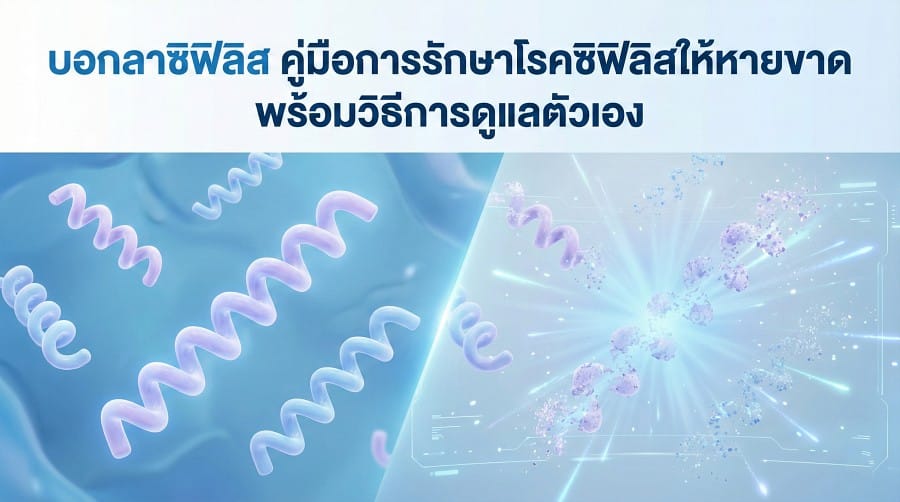
Contents
Syphilis is a sexually transmitted infection (STI) caused by a bacterium. In 2019, Thailand's Ministry of Public Health designated syphilis as a notifiable disease to be monitored, because the number of cases has risen rapidly over the past 10 years. Syphilis can affect both men and women, and most cases are found in young people aged 15-24. The main way syphilis is passed on is through sexual contact.
In the early stage, a person may develop small sores, which are most often found on the genitals, mouth, anus, or vagina. In many cases, however, the body of a person who has contracted syphilis does not show clear symptoms early on. If someone is unaware of the infection and leaves it untreated for a long time, syphilis can progress and become far more severe.
What causes syphilis?
Syphilis is caused by infection with the bacterium Treponema pallidum. This bacterium can enter the body through contact with, or direct exposure to, sores, cuts, and scratches on the skin, as well as through the body's mucous membranes. Most often, the body takes in the bacterium through sexual contact. In addition, a pregnant woman who has syphilis can pass the infection to the fetus, resulting in congenital syphilis. This can cause the baby to be born prematurely, to have blindness, deafness, or neurological problems, and to die during infancy, or in severe cases even to die in the womb.
How is syphilis transmitted?
- Contact with the bacterium: when you come into contact with the bacteria that cause syphilis, they can enter your body.
- Sexual contact, whether anal or vaginal, as well as kissing or oral sex.
- Transmission from an infected mother to her baby during pregnancy or childbirth.
How many stages does syphilis have?
Syphilis presents with different symptoms at each stage. Some people may have overlapping symptoms, or symptoms that appear out of order rather than following the stages in sequence. The disease has four stages in total:
- Stage 1: Primary Stage
- Stage 2: Secondary Stage
- Latent Stage
- Stage 3: Tertiary Stage
The stages of syphilis symptoms are described below.
Syphilis Stage 1
These are the earliest symptoms of syphilis infection. A person develops a small, firm, red sore that doctors call a "chancre," appearing on the vagina, genitals, under the foreskin, the anus, or the mouth. Some people have only a single sore, while others have several. The sore is painless. It usually appears about 10 days to 3 months after the bacterium enters the body, though in some people it can appear as early as 3 weeks. These symptoms then heal on their own within 3-6 weeks. Even so, the syphilis bacteria are still spreading through the person's body.
Syphilis Stage 2
These symptoms appear about 1-3 months after the chancre heals. The person develops a rash and raised bumps that resemble warts, on the torso, palms, soles, and genitals; some people may have a rash on other parts of the body as well. This rash does not itch, but it may be accompanied by muscle aches, fever, sore throat, fatigue, hair loss, or abnormally swollen lymph nodes. These symptoms may clear up on their own, or return again later.
- Fever
- Sore throat
- Swollen lymph nodes
- Muscle aches in some people
Latent (asymptomatic) syphilis
The latent stage develops in the more than 30% of people who do not receive proper, appropriate treatment during stage 2, and from there the disease can progress to stage 3 more easily. During the latent stage, the syphilis bacteria remain in the body for many years without producing any clear symptoms.
Clinically latent syphilis is dangerous because it can still be passed to a sexual partner if you have sex without a condom.
Syphilis Stage 3
This is the final stage for a person with syphilis. It results from not receiving proper, timely treatment, and it usually appears 10-20 years after infection. The bacteria spread throughout the body, causing progressively more damage. In this stage the symptoms are clearly evident, and can include dementia, blindness, paralysis, deafness, heart disease, sexual dysfunction, and, ultimately, death.
These do not spread syphilis
- Sitting on a toilet seat or using the same bathroom
- Hugging or shaking hands
- Sharing personal belongings
- Eating together and sharing dishes
- Swimming in the same pool or sharing exercise equipment
How can you tell if you have syphilis?
Most people find out they have syphilis only when they donate blood, are screened during pregnancy, or have an annual health check-up. So if you have the opportunity, it is worth getting tested for syphilis at least once. The people who should be tested include those at highest risk: young people and gender-diverse people, men who have sex with men, pregnant women or those planning to have children, and people living with HIV or whose partners are living with HIV, among others.
Syphilis can be diagnosed by testing fluid from a sore in the first stage, or through a blood test. There are three testing methods:
The Dark Field Exam uses a microscope to look for the bacteria. It can be used to make a diagnosis from a sample taken from the skin, from fluid from a sore, or from a rash suspected of being syphilis in the first or second stage.
Blood tests that check for the body's immune response to the syphilis bacteria are divided into:
- Blood tests for an initial immune response, which are not specific to syphilis, such as the VDRL or RPR tests, done after infection and once the first symptoms begin to appear. If the result is positive, another blood test is needed to confirm the diagnosis.
- Blood tests that confirm the diagnosis and are specific to syphilis, such as FTA-ABS (Fluorescent Treponemal Antibody Absorption test) or MHA-TP (Microhemagglutination assay for Treponema pallidum). With these tests, someone who has had syphilis before may still test positive even after being cured, without currently having the disease.
A cerebrospinal fluid test is used in cases where an infection of the nervous system is suspected.
How syphilis is transmitted
The bacterium Treponema pallidum that causes syphilis can enter the body in three main ways: through sexual contact with someone who has syphilis; through contact with sores on an infected person's body via the skin, sores on the lips, sores in the mouth, or mucous membranes; and finally, through transmission from an infected mother to the fetus. Syphilis cannot be passed on by sharing personal items, clothing, or towels, through close physical contact, by eating together, or by touching shared objects.
Syphilis and newborns
A newborn can contract syphilis from a mother who is infected during pregnancy; this is called "congenital syphilis." It happens when the mother has not had a blood screening test, or has not consulted a doctor to plan a pregnancy in advance. She may not know that she is infected, or she may have contracted it from her husband.
Congenital syphilis raises the chance that the mother will give birth prematurely, that the baby will die in the womb, or that the baby will die after being born. A baby born prematurely may also have deafness, blindness, or neurological abnormalities. Even though the condition can be detected and treated promptly, parents should be aware of the potentially fatal consequences for their baby if they do not undergo syphilis screening before having children.
Treatment of syphilis
Today, syphilis can be treated with antibiotics in the penicillin group (Penicillin), which are the most effective medicines for treating syphilis. A doctor chooses the dose and amount based on the person's symptoms, giving injections over a continuous period so that the antibiotic keeps working to destroy the bacteria.
- Stage 1 and stage 2: Benzathine penicillin G, given as a single intramuscular injection of 2.4 million units.
- Latent stage and stage 3: Benzathine penicillin G, given as intramuscular injections of 2.4 million units once a week for 3 weeks.
- When syphilis has reached the brain: Aqueous crystalline penicillin G, 3-4 million units given intravenously every 4 hours for 10-14 days; or Procaine penicillin given intramuscularly once a day at 2.4 million units, together with Probenecid taken 4 times a day.
- For people who are allergic to penicillin: another oral medication is used instead, such as erythromycin, which must be taken continuously for 1 month.
For congenital syphilis: Aqueous crystalline penicillin G at a dose of 50,000 units per kilogram, given IV every 12 hours for 1 week, or every 8 hours for 10-14 days.
The relationship between syphilis and HIV
Many people worry about whether syphilis is the same as AIDS. In reality, the two are different, but they can be transmitted in similar ways, namely through sex without a condom. Syphilis can be completely cured, while there is not yet a cure for HIV. However, taking antiretroviral therapy (ART) consistently helps people living with HIV avoid progressing to AIDS and lowers the risk of complications and future illness. As with syphilis, if HIV is not treated promptly, it too can progress.
| Infectious disease | Fact |
|---|---|
| Risk | People who have syphilis are 2-5 times more likely to contract HIV than people who do not have the disease. |
| Cause | A chancre that may bleed during sex provides a route of entry for HIV. |
| Complications | Syphilis affects the heart and brain, causing various complications such as aneurysms, aortitis (inflammation of the aorta), hemorrhagic stroke, meningitis, deafness, and blindness. |
Read related articles about syphilis
How to prevent syphilis
The principles for preventing syphilis are the same as for other sexually transmitted infections: reducing the risk of picking up the infection from someone who has it. These include:
- Abstaining from sex: Avoiding sexual activity, or staying in a monogamous relationship with a partner who does not have syphilis, helps reduce the risk of exposure, although in practice this can be quite difficult.
- Using condoms: Using latex or polyurethane condoms consistently and correctly during sex can greatly reduce the risk of syphilis and other STIs. It also helps to avoid frequently changing sexual partners.
- Regular screening: People who are sexually active, especially those with multiple partners or high-risk behaviors, should have regular blood screening for syphilis as well as HIV testing. Early detection allows for timely treatment and reduces the risk of complications.
- Preventive treatment for people at high risk: For some high-risk groups, such as men who have sex with men and people living with HIV, a doctor may recommend preventive treatment for syphilis, which generally involves standard doses of antibiotics.
- Communication and education: Open, honest communication with sexual partners about sexual health, STI status, and risk can support well-informed decisions about safer sex.
- Health education and awareness: Public health campaigns and education programs can raise awareness about syphilis, how it is transmitted, and how to prevent it. Knowledge helps people take appropriate protective measures.
- Vaccination: Although there is no vaccine for syphilis, being vaccinated against other STIs can help reduce the risk of additional infections.
- Planning before having children: Pregnant women should be screened for syphilis before delivery, so that any infection can be detected and treated early to prevent transmission to the baby during childbirth.
- Not sharing needles: Syphilis can be passed through blood, so sharing injection needles also carries a risk. So if you have not sought treatment, it is better to use your own needles.
Where to get treatment for syphilis
| Province | Universal Coverage (Gold Card) | Social Security | Private | Clinic |
|---|---|---|---|---|
| Bangkok | Free care | Free care | Self-pay | Self-pay |
| Other provinces | Free care | Free care | Self-pay | Self-pay |
In summary, syphilis is a sexually transmitted infection caused by the bacterium Treponema pallidum. It is primarily transmitted through sex, including vaginal, anal, and oral sex. Syphilis infection progresses through several stages. Left untreated, it causes sores at the site of infection, a rash, fever, and flu-like symptoms, before entering the latent stage in which no symptoms are visible, and finally a stage that causes severe damage to the body's organs and systems.
Syphilis can also be passed from an infected mother to her baby during pregnancy or childbirth, leading to congenital syphilis. Prevention involves practicing safer sex by using condoms consistently and correctly, having a single partner, and getting regular STI testing. Everyone's awareness, along with screening for couples who want to have children, are key elements that ultimately help control the spread of syphilis.
Verified references
Links and relevance to the article’s main topic were reviewed on 13 August 2026. Each source supports only the scope stated in the original document and does not replace personalised medical, legal, or service advice.
- CDC: About Syphilis Accessed 13 August 2026
- CDC: STI Treatment Guidelines Accessed 13 August 2026