Possible Side Effects of ART and How to Respond
Antiretroviral therapy (ART) is at the heart of HIV treatment, and doctors will carefully assess when a person should begin taking these medications.
อ่านภาษาไทย
Contents
Antiretroviral therapy (ART) is the cornerstone of HIV treatment today. Beyond suppressing the virus from multiplying in the body, ART helps people living with HIV stay healthy and continuously improve their quality of life. Starting antiretroviral medication as soon as possible after diagnosis is strongly recommended by clinicians—not only to protect the health of the person diagnosed but also to reduce the chance of transmitting HIV to others. That said, even though modern ART is far more effective and safer than older regimens, ART side effects can still occur in some individuals and vary by drug and by person. Understanding these potential effects—and how to respond—helps you care for yourself correctly, avoid stopping medication on your own, and manage any unwanted symptoms with confidence. In this article, we clarify common side effects of HIV Antiretrovirals and share practical ways to cope and self-care, so everyone on treatment can live confidently and stay healthy for the long term.
List of Contents
- What Are Antiretroviral Drugs?
- How Many Classes of HIV Antiretrovirals Are There?
- What Side Effects Occur with Each HIV Medicine?
- Tips for Managing HIV Treatment Side Effects
- Understanding HIV Treatment Side Effects
What Are HIV Antiretroviral Drugs?
Antiretroviral drugs work by blocking stages of the HIV lifecycle, preventing the virus from destroying CD4 (T-helper) cells. When taken every day as prescribed, viral load falls to undetectable levels—known as “U=U” (Undetectable = Untransmittable)—which means a person does not sexually transmit HIV while undetectable. ART does not eradicate the virus, but it controls HIV so people can live normal, healthy lives and prevent long-term complications.
How Many Classes of HIV Antiretrovirals Are There?

Today’s antiretroviral drugs (ARVs) target HIV at multiple steps. Guidance from 2024–2025 emphasizes safer, longer-acting options with fewer side effects than in the past. Current ARVs commonly used in care can be grouped into six major classes:
1. Nucleoside/Nucleotide Reverse Transcriptase Inhibitors (NRTIs)
The foundation of nearly every regimen. These drugs block the virus from building its DNA during the first step of replication, so HIV cannot multiply
Commonly used drugs today:
- Tenofovir disoproxil fumarate (TDF)
- Tenofovir alafenamide (TAF)
- Emtricitabine (FTC)
- Lamivudine (3TC)
- Abacavir (ABC) (only for people who test HLA-B57:01 negative for the hypersensitivity gene)*
Note: Older drugs such as Didanosine (ddI), Stavudine (d4T), Zidovudine (AZT), and Zalcitabine (ddC) are rarely used today because of their high rate of side effects
2. Non-Nucleoside Reverse Transcriptase Inhibitors (NNRTIs)
This class acts on the same enzyme as NRTIs but binds at a different site, blocking the virus from copying its RNA into DNA.
Commonly used drugs:
- Doravirine (DOR) – a newer drug with a low rate of side effects
- Rilpivirine (RPV) – works well for people with a low viral load (viral load below 100,000 copies/mL, <100,000)
Older drugs such as Efavirenz (EFV), Nevirapine (NVP), Delavirdine (DLV), and Etravirine (ETR) now play a smaller role because of their nervous-system and liver side effects.
3. Protease Inhibitors (PIs)
This class blocks the protease enzyme the virus uses to build new proteins, so the newly formed virus is incomplete and cannot infect cells.
Drugs used today:
- Darunavir/ritonavir (DRV/r) or Darunavir/cobicistat (DRV/c)
- Atazanavir/cobicistat (ATV/c) (used in select cases)
Today this class is mainly used for people with drug-resistant HIV, or when an Integrase inhibitor–based regimen isn’t an option.
4. Integrase Strand Transfer Inhibitors (INSTIs)
This is the “most modern” class and serves as the mainstay of treatment today because it is highly effective, has few side effects, and is slow to develop resistance. It blocks the Integrase enzyme, which the virus uses to insert its own DNA into human DNA
Commonly used drugs:
- Bictegravir (BIC)
- Dolutegravir (DTG)
- Raltegravir (RAL)
- (Elvitegravir (EVG) still appears in some combination pills but is no longer a first-choice option)
5. Entry/Fusion/Attachment Inhibitors
This class acts “before the virus enters human cells,” helping to prevent HIV from attaching to and fusing with the cell wall.
Drugs in this class:
- Maraviroc (MVC) – blocks the CCR5 receptor the virus uses to enter cells
- Enfuvirtide (ENF/T-20) – an injectable that blocks the virus from fusing with the cell
- Fostemsavir (FTR) – an attachment inhibitor for people with multidrug-resistant HIV
- Ibalizumab (IBA) – an injectable monoclonal antibody (used in hard-to-treat cases)
6. Capsid Inhibitor (a newer long-acting drug)
This is the newest, most innovative class, acting on the virus’s outer shell (capsid) so it cannot replicate. The representative drug is Lenacapavir (LNP), which can be given as just two injections a year (every 6 months)
Key advantages of Lenacapavir:
- Used to treat people with multidrug-resistant HIV
- In 2025, the U.S. Food and Drug Administration (FDA) approved it as PrEP injected every 6 months under the brand name Yeztugo®
What Side Effects Occur with Each HIV Medicine?
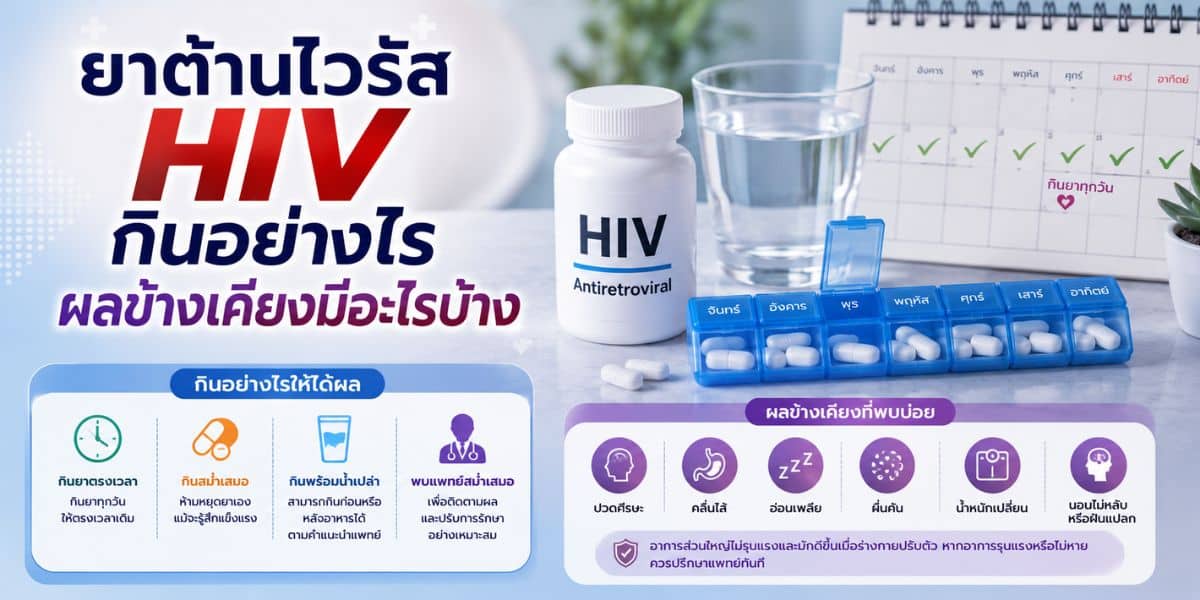
Most mild symptoms tend to improve on their own within the first 1–4 weeks. Never stop your medication on your own—always tell your doctor so they can consider adjusting or switching your regimen.
NRTI Class (the foundation of nearly every regimen)
TDF (Tenofovir disoproxil fumarate)
- Common side effects: nausea, diarrhea, mild muscle aches
- Cautions: reduced kidney function / bone thinning. Best for people with normal kidney function, with periodic monitoring of kidney function and bone density.
ABC (Abacavir)
- Side effects: severe drug hypersensitivity
- Cautions: test for HLA-B*57:01 before starting; some data point to a heart-disease risk in certain people—assess case by case.
TAF (Tenofovir alafenamide)
- Common side effects: possible weight/fat gain, mild digestive symptoms
- Advantages: overall gentler on the kidneys and bones than TDF
FTC (Emtricitabine) / 3TC (Lamivudine)
- Side effects: headache, nausea, mild rash (usually resolves on its own)
- Paired with TDF/TAF as the backbone of modern regimens
INSTI Class (the backbone of today’s regimens)
BIC (Bictegravir) / DTG (Dolutegravir)- Side effects: insomnia/dizziness early on, possible slight weight gain
- Strengths: potent, suppresses the virus quickly, few side effects—well suited as a first-line regimen for most people
- Side effects: nausea, headache, rash (uncommon)
- Used as an alternative when BIC/DTG isn’t suitable
HIV Antiretroviral Side Effects: NNRTI Class (now used more selectively)
DOR (Doravirine)
-
Side effects: headache, nausea, mild insomnia—generally well tolerated
RPV (Rilpivirine)
- Side effects: headache, insomnia, depressed mood in some people
- Key limitation: appropriate to start only in people with a viral load below 100,000 copies/mL (<100,000) and CD4 above 200 (>200) cells/mm³ (to avoid treatment failure)
Older NNRTIs such as EFV, NVP now play a smaller role because of nervous-system or liver side effects and drug resistance.
PI Class (Protease Inhibitors)
DRV/r or DRV/c (Darunavir/ritonavir or Darunavir/cobicistat)
- Side effects: diarrhea, nausea; triglycerides/cholesterol/blood sugar may rise
- Used when there’s a history of drug resistance or when INSTIs can’t be used
ATV/c (Atazanavir/cobicistat) (used only in select cases)
-
Side effects: yellowing of the skin and eyes from high unconjugated bilirubin, digestive symptoms
HIV Antiretroviral Side Effects: Entry, Attachment, and Post-Attachment Inhibitors
Maraviroc (MVC) – blocks the CCR5 receptor
-
Side effects: abdominal pain, dizziness, cough, rash, mild fever
Fostemsavir (FTR) – Attachment inhibitor
-
Side effects: nausea, abdominal pain, headache
Ibalizumab (IBA) – Monoclonal antibody (post-attachment)
-
Side effects: rash, diarrhea, dizziness (given to people with multidrug-resistant HIV)
Enfuvirtide (ENF/T-20) – Fusion inhibitor (subcutaneous injection)
-
Side effects: pain/swelling/itching at the injection site
HIV Antiretroviral Side Effects: Newer Long-Acting Drugs
Cabotegravir + Rilpivirine (Long-acting for “treatment”)
- Injected every 1–2 months in people who already have good viral suppression
- Side effects: pain/lumps at the injection site, headache, nausea (usually mild)
Lenacapavir (Capsid inhibitor)
- Used to treat people with multidrug-resistant HIV, and in 2025 it was approved as “PrEP injected every 6 months” (brand name Yeztugo® in the U.S.)
- Side effects: injection-site reactions, headache, nausea (generally well tolerated)
Tips for Coping
- Never stop your medication on your own, and always keep your follow-up appointments as your doctor advises
- Mild symptoms when starting treatment (dizziness/insomnia/nausea) usually improve within 1–4 weeks
- Tell your doctor right away if you have a whole-body rash, difficulty breathing, yellowing of the eyes or skin, or severe abdominal pain
- Get periodic blood tests to monitor kidney/liver function, lipids, blood sugar, and body weight
HIV Antiretroviral Side Effects at Each Stage
Today’s HIV antiretrovirals are highly effective, much safer, and far less likely to cause serious side effects than in earlier eras. Even so, some unwanted symptoms can still occur, and they fall into two main stages:
Short-Term Side Effects (the first 1–4 weeks of starting treatment)
These symptoms are usually mild and resolve on their own as the body adjusts, such as:
- Nausea, vomiting, diarrhea
- Dizziness, grogginess, insomnia
- Headache, mild rash
- Unusual dreams or mood swings (in some people)
How to cope: drink plenty of water, eat light meals, get enough rest, and don’t stop your medication on your own. If symptoms are very bothersome, tell your doctor so they can consider adjusting your regimen.
Long-Term Side Effects (developing after months or years of treatment)
These are uncommon but worth watching for, such as:
- Effects on the kidneys and bones → most often seen with TDF
- Weight gain / high cholesterol → seen with TAF and INSTIs (DTG, BIC)
- Hepatitis (liver inflammation) → use caution in people with liver disease or on certain NNRTIs
- Severe drug hypersensitivity → especially with Abacavir (ABC); test HLA-B57:01* before starting
- Yellowing of the skin and eyes → seen with Atazanavir (ATV)
- High blood sugar or high cholesterol → seen with protease inhibitors such as DRV/r
Serious Side Effects (uncommon, but seek medical care promptly)
- Whole-body rash / difficulty breathing / swollen lips → could be a severe allergic reaction
- Yellowing of the skin and eyes, severe abdominal pain → possible hepatitis
- Severe muscle pain / sudden weakness
- High fever, or persistent nausea and vomiting

Summary: HIV Antiretroviral Side Effects
Although HIV antiretrovirals must be taken continuously for life, today’s medical advances have made them safer, serious side effects are rare, and regimens can be effectively tailored to each person. That’s why understanding the medications’ side effects and closely monitoring your own symptoms matters so much: it helps people living with HIV respond in the right way, avoid unnecessary worry, and stay on treatment without stopping on their own.
The most important thing is open, honest communication with your doctor or pharmacist whenever you notice something unusual, so you receive the best advice and the most appropriate medication adjustments. Antiretroviral treatment today not only keeps the virus “undetectable” but also lets people living with HIV live strong, long lives with a quality of life no different from anyone else’s—as long as they care for themselves correctly and consistently.
References:“Antiretroviral drugs may cause some side effects, but staying on continuous treatment is a vital step toward a life that is stable, safe, and full of hope every day.”
- Drug side effects and medication adherence among people living with HIV
- Antiretroviral Treatment of Human Immunodeficiency Virus (HIV) Infection
- New alternative antiretroviral options for treating people living with HIV
Verified references
Links and relevance to the article’s main topic were reviewed on 13 August 2026. Each source supports only the scope stated in the original document and does not replace personalised medical, legal, or service advice.
- NIH HIVinfo: HIV Treatment Basics Accessed 13 August 2026
- NIH HIVinfo: HIV Medicines and Side Effects Accessed 13 August 2026
- WHO: HIV and AIDS fact sheet Accessed 13 August 2026