


New Year is a time many people look forward to, whether for traveling, meeting new people, or enjoying social gatherings and celebrations in ways that may not be possible during the rest of the year. However, beyond the joy and relaxation, the festive season is also a time when taking care of one’s health, especially reducing HIV risk becomes increasingly important. Certain behaviors that naturally arise in fun and carefree environments can unintentionally increase risk without people realizing it. During holidays, decisions are often made more quickly and with less caution. This may include having sex without proper protection, consuming alcohol or stimulants during social events, or letting the festive atmosphere lower awareness of sexual safety. A common question many people ask is whether it is truly possible to reduce HIV risk during a New Year celebration filled with parties and activities. In reality, reducing HIV risk does not mean limiting enjoyment or avoiding activities altogether. It is about having the right knowledge, awareness, and preparation—so you can enjoy the holiday with confidence and start the new year with peace of mind.
Reducing HIV Risk During New Year Celebrations
Many people wonder why festivals and holidays are often associated with higher HIV risk and other infections. The answer is simple: the “relaxed” and “high-energy” nature of holidays significantly influences risk-related behaviors, such as:
- Increased alcohol consumption → reduced decision-making ability
- New locations and new people → higher chances of sex with unfamiliar partners
- Lack of preparation → unplanned sexual encounters
- Party environments that encourage letting go → greater likelihood of unprotected sex
In many cases, a little planning can reduce risk by more than half.
How to Plan Before Your Trip: The Starting Point for Reducing HIV Risk During New Year Travel
To truly “enjoy your trip without compromising your health,” start with these simple preparation steps:
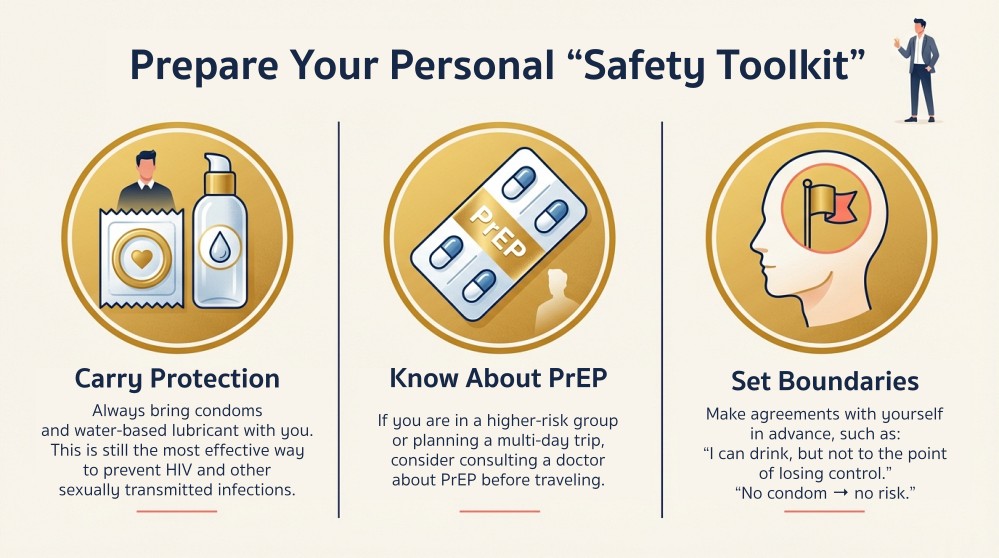
- Carry quality condoms
- Bringing condoms is not embarrassing—it is a sign of responsibility toward yourself and your partner. Recommended items include:
- Properly sized condoms
- Latex-free condoms (for those with latex allergies)
- Water-based lubricant
- Remember: condoms remain the most effective primary method for reducing HIV risk and preventing sexually transmitted infections.
- Bringing condoms is not embarrassing—it is a sign of responsibility toward yourself and your partner. Recommended items include:
- Prepare PrEP if you are frequently at risk
- For individuals who occasionally have unprotected sex, PrEP can significantly reduce HIV risk. If you plan to travel for several days or visit nightlife venues frequently, consult a doctor or clinic before your trip.
- Set personal rules before drinking
- Many risky situations happen not because of intention, but because of impaired judgment. Consider setting boundaries in advance, such as:
- Drinking is okay—but not to the point of losing control
- No condom → no risk-taking
- Going home with someone should feel both safe and comfortable
- Many risky situations happen not because of intention, but because of impaired judgment. Consider setting boundaries in advance, such as:
- Check where to buy protection at your destination
- Some areas may have limited access to condoms or lubricants. Preparing in advance is always the safest option.
- Inform a trusted friend
- Letting a close friend know that you may have plans later is not embarrassing—it helps ensure safety if support is needed.

5 Simple Ways of Reducing HIV Risk While Having Fun
Many people worry that reducing HIV risk during New Year celebrations will take away the excitement. In reality, it simply means being discreetly cautious.
Practical actions you can take immediately:
- Drink gradually and avoid blacking out
- Step away if you feel unsafe
- Never drink from a stranger’s glass
- Set clear boundaries when you meet someone you like
- Always use a condom, regardless of the type of sexual activity
Example scenarios
| Situation | What to Do | Why It Matters |
|---|---|---|
| Meeting someone at a club | Talk openly about condoms before starting | Protects both partners fairly |
| Feeling very intoxicated | Inform a friend or stop drinking | Prevents risky decisions |
| Thinking “It’ll probably be fine” | Pause and reassess | Most risks occur at this moment |
What to Do After Unprotected Sex?
Even with good preparation, mistakes can happen—and it does not mean it’s “too late.” Today, we have additional protection options such as PEP.
What is PEP?
PEP is medication that helps prevent HIV infection after potential exposure. It must be taken within 72 hours—the sooner, the more effective.
What should you do after a party night?
- If you think you were at risk → go to a clinic immediately
- If you are unsure → consult a healthcare provider
- If there is pain or injury → inform staff for further risk assessment
Acting quickly can significantly reduce the chance of infection.

Risk Behaviors vs. Safer Alternatives
| Behavior | Risk Level | Safer Approach |
|---|---|---|
| Sex without condoms | High | Use condoms every time |
| Heavy drinking with memory loss | High | Drink with awareness |
| Multiple new partners in one night | Moderate–High | Discuss safety beforehand |
| Irregular PrEP use | Moderate | Take PrEP consistently |
| Buying protection from unreliable sources | Moderate | Bring trusted supplies |
✔ New Year Travel Checklist for Reducing HIV Risk
- What to carry
- At least 2–3 condoms
- Lubricant
- PrEP medication (if you are on it)
- Inhaler or basic pain relief
- Contact information for clinics offering PEP
- What to remember
- You can drink—but stay safe
- If you’re not ready → don’t take the risk
- Simply asking “Shall we use a condom?” instantly increases safety
- If something goes wrong → seek PEP
- Prevention is the best New Year gift you can give yourself.
Other Recommended Articles
A New Perspective on HIV Prevention
Some people worry that being cautious will ruin the mood. In reality, safety is what allows you to fully enjoy the moment without long-term worry. Think about it this way:
“One night of fun should not cost years of stress.”
Good preparation does not reduce freedom—it actually increases it, because you feel confident and protected in every situation.
Polite conversation examples that help reduce risk
If you feel shy about asking your partner to use a condom, try these natural phrases:
- “I’ve got protection—let’s use it so we can relax.”
- “Let’s make it safe for both of us.”
- “Using a condom will help us enjoy tonight without worry.”
- “I have lubricant too—it’ll be more comfortable.”
Clear communication often works best and helps both partners feel responsible together.
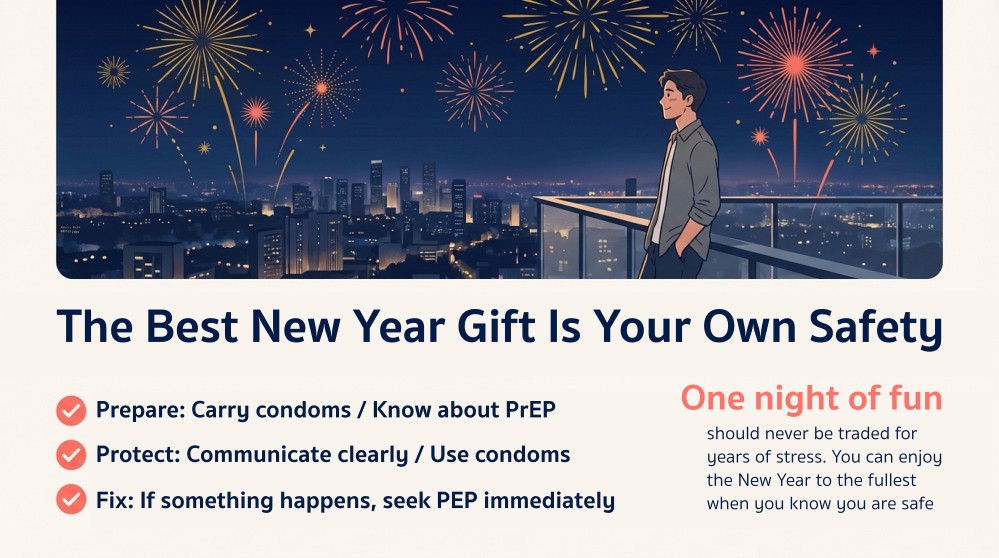
Conclusion: Reducing HIV Risk During New Year Travel Is Possible and Everyone Can Do It
Reducing HIV risk during New Year travel is not complicated, not embarrassing, and not limited to any specific group. It is something everyone can do through preparation, planning, and maintaining personal safety standards. The New Year should be a time of happiness—not the beginning of future worries. Being prepared is the best gift you can give yourself.
References:
- Basics of HIV Prevention
- Pre- and Post-Exposure HIV Prevention
- Unprotected Sex and HIV Risk